
Why Did ChatPic Really Shut Down? The Full Legal and Technical Story
The Answer Most Sites Give — and Why It Is Incomplete
Ask almost any site covering this topic why ChatPic shut down, and you will get a version of the same short answer: it hosted illegal content, faced legal pressure, and closed in 2023. That is true. It is also about as useful as saying a building collapsed because it fell down.
What actually happened to ChatPic was a multi-year, multi-continent sequence of events involving a Greek petition that reached the European Parliament, formal complaints to one of the most powerful child protection organisations in the United States, the withdrawal of payment infrastructure, and the silent refusal of hosting companies to continue serving the platform — all converging on a platform whose operators had built something structurally incapable of responding to any of it.
This is the full story, told in the order it happened.
What ChatPic Was Built to Do — and the Flaw Baked In From Day One

ChatPic launched around 2014 as a frictionless image-sharing platform. Anyone could visit the site, select a photo from their device, and upload it in seconds. No email required. No password needed. No personal information collected. The site gave you a direct link to your image that could be shared anywhere — on Reddit, Twitter, Discord, or forums. The process took less than 30 seconds from start to finish.
The platform’s design philosophy was total anonymity at every layer. Users were anonymous. Uploads were anonymous. There were no accounts to trace content back to. No email addresses to identify uploaders. No phone numbers. No payment information. No IP address logging in any way that enabled accountability. When you uploaded an image to ChatPic and walked away, you left no footprint at all.
This was the product’s value proposition — and it was also the single design decision that made everything that followed inevitable.
Most legitimate image hosts use automated scanning tools. Companies like Imgur employ PhotoDNA technology from Microsoft to detect illegal images. ChatPic had none of this protection. The site relied entirely on user reports, which were often ignored.
PhotoDNA works by converting known illegal images into a digital fingerprint — called a hash — and then comparing every new image upload against a database of those fingerprints maintained by the National Center for Missing and Exploited Children (NCMEC). A match triggers an automatic block and a mandatory report to authorities. Hash matching tools compare files against known CSAM hashes and are used by every responsible hosting platform as a baseline requirement.
ChatPic implemented none of this. Not PhotoDNA. Not NCMEC integration. Not the UK’s IWF Image Intercept. Not Canada’s Project Arachnid Shield. Not any equivalent tool from any jurisdiction. Images were uploaded, hosted, and served with no scanning before or after publication. The platform’s moderation system, to the extent one existed at all, was: wait for a user to report something, then maybe remove it.
At a small scale, this was survivable. With millions of daily page views, it was catastrophic.
2020: The First Formal International Action

The public record of ChatPic’s legal troubles begins not in a US federal court but in a Greek petition and a formal question to the European Parliament.
In late 2020, a Greek MEP raised an official parliamentary question — Question E-006622/2020 — to the European Commission. The question documented that hundreds of men were using chatpic.org daily to share and illegally download pictures and videos of women — mainly from their social media accounts — without their permission or knowledge. Personal images, often of sexual content, of women and girls, including sometimes underage individuals, had been uploaded without consent. Some material was housed in private channels requiring an invitation code, suggesting organised distribution rather than casual misuse.
The question asked what action the European Commission could take to shut down the platform. The Commission’s formal response, published in March 2021, confirmed that INHOPE hotlines had received 54 complaints against chatpic.org, hosted in the United States. The Commission noted that all reported images depicted adults, which at that stage limited the direct legal options available under child protection law — but acknowledged the broader harm and noted that the proposed Digital Services Act would create new cross-border obligations for platforms like ChatPic even if headquartered outside the EU.
At the same time, a Change.org petition targeting the platform had gathered thousands of signatures — primarily from Greece, where the platform had developed a particularly concentrated user base targeting Greek women. The petition documented that victims’ personal details, including addresses, school names, and social media usernames, were being shared alongside images — enabling real-world stalking and harassment beyond the original privacy violation.
This was 2020 and early 2021. ChatPic was still operational, still growing, and its operators had still not implemented any meaningful response to the abuse that was already formally documented at the European parliamentary level.
2021–2022: NCMEC Involvement and Escalating Pressure
The period from 2021 to 2022 represents the turning point — the moment when ChatPic’s problems shifted from being documented to being acted upon by organisations with real enforcement power.
By mid-2023, ChatPic faced investigations from authorities in multiple countries. The National Center for Missing and Exploited Children reported the platform to federal agencies.
NCMEC is the United States’ congressionally mandated national clearinghouse for child sexual exploitation. Every online platform operating in the US is legally required under 18 U.S.C. § 2258A to report child sexual abuse material (CSAM) to NCMEC’s CyberTipline when they become aware of it on their platform. The inverse of this obligation is also significant: when NCMEC receives reports about a platform from external sources — the public, other organisations, law enforcement — it can escalate those reports to the FBI, Homeland Security, and international law enforcement partners.
ChatPic had never integrated with NCMEC. It had never implemented PhotoDNA. It had never submitted a CyberTip report. For a platform of its size, by 2018–2023, chatpic.org was receiving over 102,000 visitors per day and 398,000 page views daily, ranking inside the global top 200,000 websites. The absence of any child safety compliance infrastructure was not just a policy failure. It was a legal liability that became increasingly impossible to ignore as reporting volumes grew.
The NCMEC CyberTipline received 36.2 million reports in 2023 alone — demonstrating the industrial scale at which online platforms were processing and reporting CSAM. A platform receiving millions of daily page views with zero compliance infrastructure, no scanning, no reporting, and no moderation was an anomaly that stood out precisely because every responsible platform around it was doing the opposite.
2022–2023: The Commercial Collapse Begins
Understanding why ChatPic ultimately closed requires understanding that platforms rarely shut down purely because of content problems. They shut down when the infrastructure required to operate becomes unavailable.
That infrastructure — hosting, payment processing, domain registration, CDN services — is provided by commercial companies with their own legal exposure, their own terms of service, and their own reputational interests. When a platform reaches the point where those companies conclude that providing services creates liability greater than the revenue earned, services are withdrawn.
By mid-2023, ChatPic faced investigations from authorities in multiple countries. The consequence of active law enforcement investigation is that every infrastructure provider serving the platform becomes a potential subject of the investigation. Hosting companies that continue serving a platform under active federal investigation for CSAM-related offences risk being called as witnesses, having their systems subject to legal process, and facing reputational damage that their other clients — often major enterprises — cannot tolerate.
Cloudflare terminates security services for content that is illegal in the United States, including Child Sexual Abuse Material, and for content subject to the Fight Online Sex Trafficking Act. When Cloudflare receives CSAM reports about a site using its services, every report leads to three actions: the report is forwarded to NCMEC, it is forwarded to the website operator, and it is forwarded to the hosting provider, including the origin IP address of where the content is located. This chain of notifications means that every CSAM complaint about a ChatPic-hosted image created a documented record at Cloudflare, at the hosting provider, and at NCMEC — making continued service provision progressively harder to justify legally.
Payment processors faced the same calculus. Payment processors cut ties with the service. Without payment processing, a platform cannot generate advertising revenue, accept donations, or pay for hosting. Without revenue, it cannot pay server bills. The sequence is mechanical: reports → investigation → infrastructure withdrawal → revenue collapse → shutdown.
October–November 2023: The Final Weeks
ChatPic went offline permanently in November 2023. According to the Internet Archive’s Wayback Machine, the last snapshot of ChatPic.org was taken on October 28, 2023. After that date, the domain stopped responding.
There was no farewell message from the operators. No announcement. No data export offered to users. No statement about what happened. The domain simply stopped resolving, the servers went offline, and years of uploaded content — including millions of images uploaded by legitimate users who had no involvement in any illegal activity — disappeared permanently with no warning.
A combination of lack of content moderation, legal pressure from multiple countries, hosting providers refusing service, and investigations tied to illegal content uploads caused the platform to collapse in 2023.
This is what platform collapse actually looks like in practice. Not a court order. Not a dramatic press conference. Not a bailiff arriving at a data centre. A sequence of quiet commercial decisions — hosting contracts not renewed, payment processors withdrawing, infrastructure services terminated — that collectively made it impossible for the platform to function, executed by companies protecting their own legal position without any single entity needing to formally “shut down” ChatPic at all.
Why the Operators Could Not Have Fixed It
A question worth examining honestly is whether ChatPic’s operators could have implemented moderation, complied with NCMEC requirements, and avoided shutdown if they had chosen to.
The answer is technically yes — but structurally, the platform’s design made meaningful compliance nearly impossible to retrofit.
PhotoDNA requires each image uploaded to be processed before publication. For a platform receiving millions of daily uploads with no user authentication, this creates both a technical bottleneck and a legal complexity: the moment a platform begins scanning content and detecting CSAM, it becomes legally obligated to report what it finds and to preserve records. A platform that has been hosting illegal content for years without reporting it, and then begins scanning, faces the question of what to do with years of historical uploads that were never scanned.
More fundamentally, compliance with NCMEC reporting requirements requires a platform to be able to identify uploaders, at a minimum, their IP address at the time of upload. ChatPic’s anonymity model had been designed to avoid exactly this. Implementing the logging infrastructure required for legal compliance would have destroyed the product’s core value proposition. Its users wanted anonymity. Its architecture had been built to provide it. Retrofitting accountability into a platform built around its absence was not a minor technical change — it was a fundamental redesign of what the product was.
The operators chose neither to retrofit compliance nor to close voluntarily. They chose instead to operate until operation became impossible, which is exactly what happened.
What ChatPic’s Shutdown Tells Us About How the Internet Actually Works
ChatPic’s story is often framed as a cautionary tale about anonymity online. That framing is partially accurate but incomplete. Anonymity itself is not the problem. Many legitimate platforms offer anonymous or pseudonymous participation without becoming vectors for illegal content. The problem was anonymity combined with no moderation, no compliance infrastructure, no legal entity willing to accept accountability, and no business model capable of funding the systems that responsible anonymity requires.
The broader lesson is about how platforms actually get shut down in 2026. Governments rarely directly close websites. What actually stops platforms is the withdrawal of the commercial infrastructure on which they depend. Hosting companies, payment processors, domain registrars, CDN providers — these entities respond to legal liability, reputational risk, and their own terms of service in ways that can make operating a non-compliant platform commercially impossible without any single government needing to obtain a court order.
Cloudflare terminates security services for content that is illegal in the United States and reports CSAM to NCMEC, forwarding both the content and the hosting provider’s details. The UK’s IWF operates globally to remove illegal content. NCMEC’s CyberTipline feeds directly into FBI and international law enforcement investigations. INHOPE coordinates removal actions across 50 countries. These organisations work in parallel, not sequentially, and a platform like ChatPic was simultaneously generating reports in multiple jurisdictions, to multiple organisations, with multiple infrastructure providers all receiving copies of the same reports.
The collapse, when it came, was inevitable from the moment the platform achieved the scale that made it worth reporting.
The Parallel: Omegle
ChatPic was not alone. Almost simultaneously in November 2023, Omegle — the anonymous video chat platform — also closed permanently. Omegle shut down due to legal pressure from lawsuits, rising reports of abuse, and the emotional toll on its founder. A massive lawsuit settlement required the platform to shut down permanently. In 2022 alone, Omegle was mentioned in over 600,000 reports made to the National Center for Missing and Exploited Children.
The two closures were unrelated operationally but identical in cause: anonymous platforms that had been built without meaningful safety infrastructure, that had scaled past the point where reactive moderation was sufficient, and that faced the simultaneous withdrawal of legal standing and commercial infrastructure. The pattern is not a coincidence. It reflects a structural reality of how regulators, law enforcement, and commercial infrastructure providers are approaching anonymous platforms in the current environment — and it tells you exactly what any platform attempting to operate in this space without compliance infrastructure should expect.
What Happened to the People Behind ChatPic

One of the most common questions about ChatPic’s shutdown is what happened to the operators. The honest answer is: we do not know, and the public record does not tell us.
ChatPic’s operators were never publicly identified. No criminal charges were publicly announced in any jurisdiction. No civil judgments were published. The domain was abandoned, the servers were switched off, and the people who ran the platform simply disappeared into the same anonymity that had been the product’s selling point.
This outcome — no prosecution, no public accountability, no identifiable responsible parties — is frustrating but not unusual. Platforms built on anonymity are also run by anonymous operators. Identifying the individuals behind a platform that deliberately collected no user data, operated through layers of infrastructure abstraction, and maintained no public corporate identity requires investigative resources that many law enforcement agencies in 2023 were not prioritising for what was, at the time, a niche image-sharing platform rather than a darknet marketplace.
Whether investigations are ongoing, whether any operators face future prosecution, and whether any jurisdiction has identified responsible individuals is information that is not in the public record as of March 2026.
Frequently Asked Questions
When exactly did ChatPic shut down?
ChatPic went offline permanently in November 2023. The last snapshot of ChatPic.org captured by the Internet Archive’s Wayback Machine was taken on October 28, 2023. After that date, the domain stopped responding.
Was ChatPic shut down by the government?
Not directly. A combination of lack of content moderation, legal pressure from multiple countries, hosting providers refusing service, and investigations tied to illegal content uploads caused the platform to collapse in 2023. No single government order closed the platform — it collapsed when its commercial infrastructure was withdrawn.
Who reported ChatPic to the authorities?
Multiple organisations across multiple countries. INHOPE hotlines had received at least 54 formal complaints against chatpic.org by early 2021, a formal parliamentary question about the platform was raised at the European Parliament, a Greek civil petition documented specific instances of abuse, and the National Center for Missing and Exploited Children reported the platform to federal agencies in the United States.
Did ChatPic host child sexual abuse material?
Some users shared illegal content involving minors. The platform couldn’t identify or ban repeat offenders. The absence of any scanning technology meant such content could be uploaded, remain accessible, and be downloaded without the platform ever being aware of it or able to remove it.
Will ChatPic ever come back?
No. The closure was driven by the withdrawal of the commercial infrastructure required to operate, not by a temporary legal dispute. The operators simply disappeared. No successor has been announced, and no credible relaunch has been identified. Any site currently using the ChatPic name is unaffiliated with the original platform.
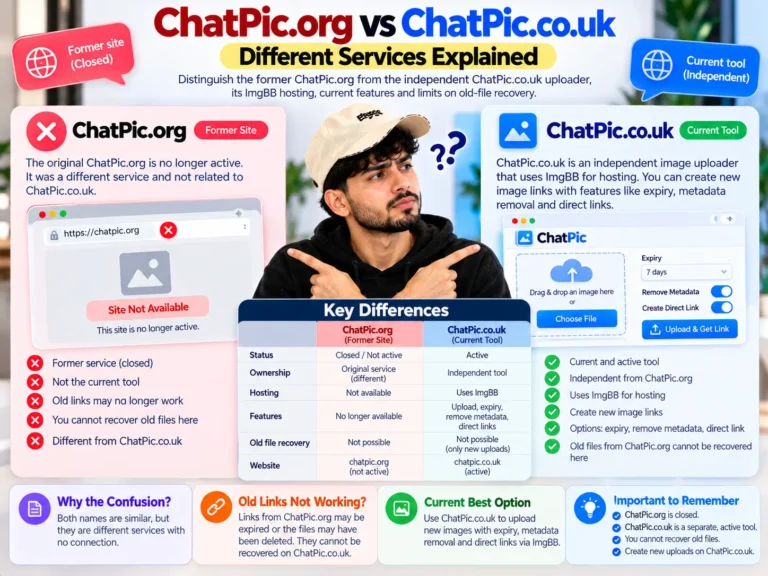
What is the difference between ChatPic and the sites using its name now?
The original chatpic.org and any site currently operating under a similar name are entirely separate entities with no connection. Sites using the ChatPic name that appeared after November 2023 are independently created, unaffiliated with the original platform, and typically unmoderated. They should be treated with caution.
Last reviewed: March 2026 · By Rizwan Aslam, Co-Founder, Finixio Digital Agency. For corrections or enquiries: info@chatpic.co.uk
This article draws on publicly available records, including the European Parliament’s official question registry, NCMEC’s published CyberTipline data, and Cloudflare’s published abuse policies. Where specific facts about ChatPic cannot be verified through primary sources, this is noted explicitly.