Why ISO 27001 Is So Important for Software Companies
For software companies, trust is one of the most valuable assets. Customers do not only buy a product, platform, or application; they also trust the company behind it with their data, workflows, integrations, and business continuity. That trust can disappear quickly after a data breach, poor access control, weak vendor management, or a failed security audit.
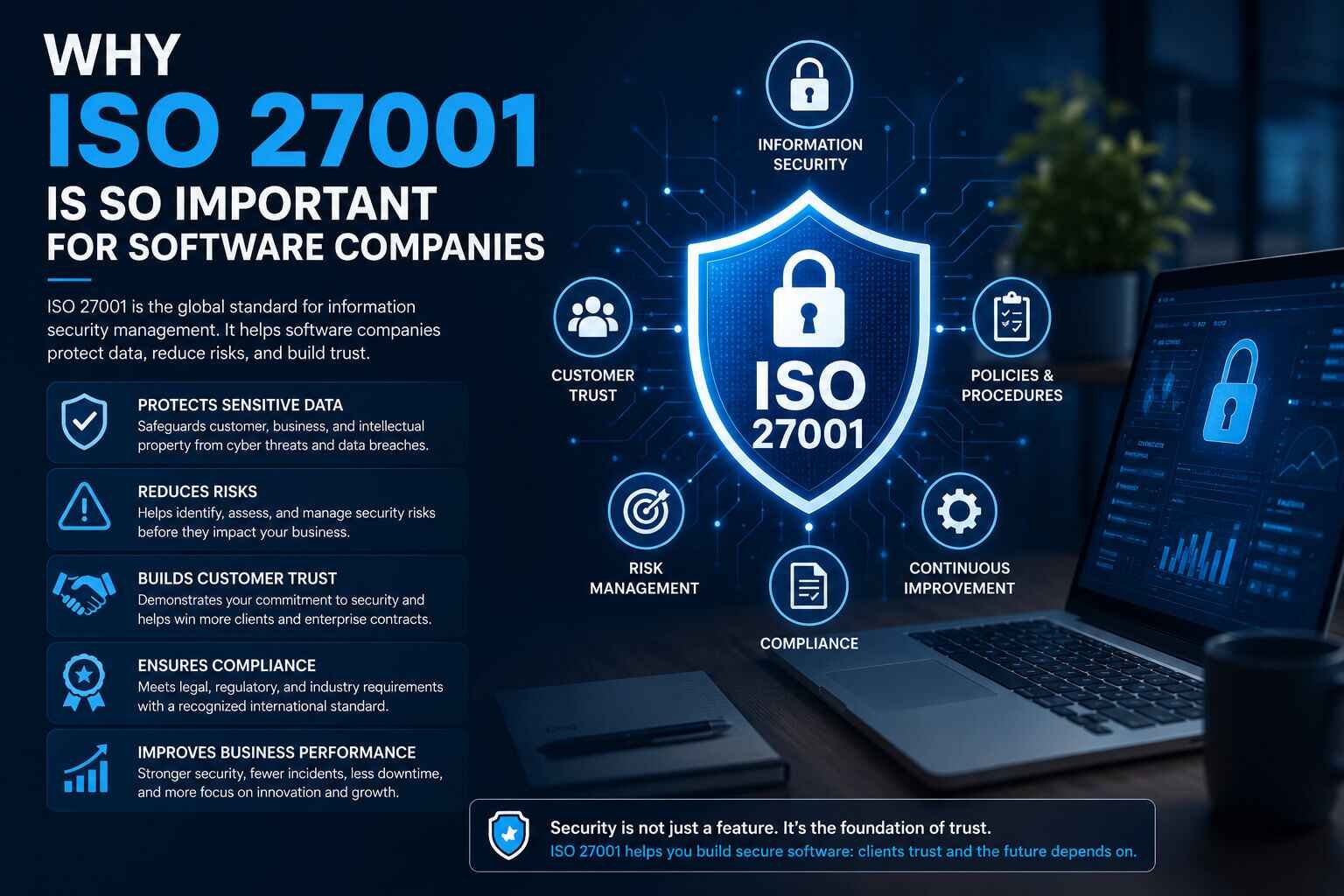
This is where ISO 27001 becomes important. ISO/IEC 27001 is the internationally recognized standard for information security management systems, often called an ISMS. It defines requirements for establishing, implementing, maintaining, and continually improving information security within an organization.
For software companies, ISO 27001 is not just a compliance badge. It is a structured way to manage security risks, prove maturity to customers, and build a stronger internal security culture. A useful starting point for companies preparing for certification is this practical ISO 27001 checklist. For additional background, you can also read the Wikipedia overview of ISO/IEC 27001.
What Is ISO 27001?A Framework for Information Security
ISO 27001 is a management system standard focused on information security. Instead of only listing technical controls, it helps organizations create a repeatable system for identifying risks, treating those risks, monitoring performance, and improving over time.
This distinction matters. Many software companies already use security tools such as firewalls, identity providers, vulnerability scanners, endpoint protection, logging platforms, and code review processes. However, without a management system, these controls can become scattered, inconsistent, or undocumented. ISO 27001 brings them together into one structured approach.
The Role of the ISMS
The core of ISO 27001 is the Information Security Management System. An ISMS defines how a company manages information security across people, processes, technology, suppliers, policies, and business objectives.
For software companies, an ISMS may cover areas such as:
Access to production systems, source code repositories, cloud infrastructure, customer databases, CI/CD pipelines, support tools, employee devices, incident response processes, and third-party integrations.
ISO 27001 helps ensure these areas are not handled casually or only when a problem occurs. Instead, security becomes part of daily operations.
Why ISO 27001 Matters for Software CompaniesSoftware Companies Handle Sensitive Data
Most software businesses process valuable information. This may include customer records, financial data, employee information, authentication tokens, API keys, intellectual property, analytics data, source code, and confidential business documents.
Even SaaS companies that do not process highly regulated data still hold information that customers expect to be protected. A breach can lead to financial loss, legal issues, reputational damage, customer churn, and lengthy recovery work.
ISO 27001 helps software companies identify what information assets they have, what threats apply to them, and what controls are needed to reduce unacceptable risks.
Customers Increasingly Expect Security Proof
Security has become a buying requirement. Enterprise customers, public-sector organizations, financial institutions, healthcare companies, and large corporates often require vendors to prove that they manage information security professionally.
Without ISO 27001, a software company may spend significant time answering long security questionnaires for every prospect. Certification does not remove every customer question, but it provides strong evidence that the company follows a recognized security standard.
For B2B software companies, ISO 27001 can therefore support sales, procurement, partnerships, and international expansion.
Security Becomes a Business Process
One of the biggest benefits of ISO 27001 is that it moves security beyond the IT department. Security becomes a business process with leadership involvement, defined responsibilities, measurable objectives, internal audits, management reviews, and continual improvement.
This is especially important for growing software companies. In early stages, security may rely on a few experienced engineers. As the company scales, that informal approach becomes risky. ISO 27001 creates structure, so security does not depend only on individual memory or personal habits.
Key Benefits of ISO 27001 for Software CompaniesStronger Risk Management
Software companies face many risks: insecure code, misconfigured cloud environments, weak authentication, excessive employee access, exposed development environments, unpatched dependencies, supply-chain attacks, and human error.
ISO 27001 requires organizations to assess information security risks and decide how to treat them. This makes security more deliberate. Instead of reacting to every possible issue randomly, the company prioritizes risks based on likelihood, impact, and business context.
This helps leadership make better decisions about where to invest time and budget.
Better Access Control
Access control is one of the most important areas for software companies. Employees, contractors, developers, support teams, and administrators may all need different levels of access.
Without a structured approach, access can become messy. Former employees may retain accounts. Developers may have unnecessary production privileges. Shared credentials may exist in tools or scripts. Admin access may not be reviewed regularly.
ISO 27001 encourages organizations to define, approve, review, and revoke access properly. For software companies, this can reduce the chance of accidental exposure, insider threats, and unauthorized changes.
Improved Incident Response
No company can guarantee that security incidents will never happen. What matters is how quickly and effectively the company detects, responds to, contains, investigates, and learns from incidents.
ISO 27001 supports incident management by requiring organizations to think about procedures, responsibilities, reporting, and improvement. This is essential for software companies because incidents can affect customer data, service availability, integrations, and trust.
A mature incident response process can reduce confusion during stressful situations. It also helps the company communicate more clearly with customers, regulators, and internal teams.
More Reliable Vendor and Supplier Management
Modern software companies depend on many third parties. These may include cloud providers, payment processors, analytics tools, CRM systems, customer support platforms, email services, monitoring tools, development platforms, and AI services.
Every supplier can introduce risk. ISO 27001 encourages companies to evaluate and manage supplier relationships from a security perspective. This does not mean avoiding third-party tools. It means understanding which suppliers matter most, what data they process, and what controls are needed.
For SaaS companies, this is particularly important because customers increasingly ask not only about the company’s own controls, but also about its supply chain.
ISO 27001 as a Growth EnablerWinning Enterprise Deals
Many software companies pursue ISO 27001 because customers ask for it. Enterprise buyers often need assurance before approving a vendor. A certified ISMS can make procurement easier and reduce friction in security reviews.
This can be especially valuable for SaaS companies selling into regulated industries or larger organizations. ISO 27001 can become a competitive advantage, especially when competitors cannot provide the same level of assurance.
Building International Trust
ISO 27001 is recognized globally. That makes it useful for software companies operating across borders. Instead of explaining a custom internal security program from scratch, the company can point to an internationally accepted standard.
This helps create trust with customers, investors, partners, and auditors in different markets.
Supporting Other Compliance Requirements
ISO 27001 can also support other compliance efforts. While it is not the same as GDPR, SOC 2, NIS2, HIPAA, or industry-specific frameworks, it creates a strong foundation for governance, risk management, documentation, access control, incident response, and continual improvement.
For companies that expect future compliance requirements, ISO 27001 can make later efforts easier.