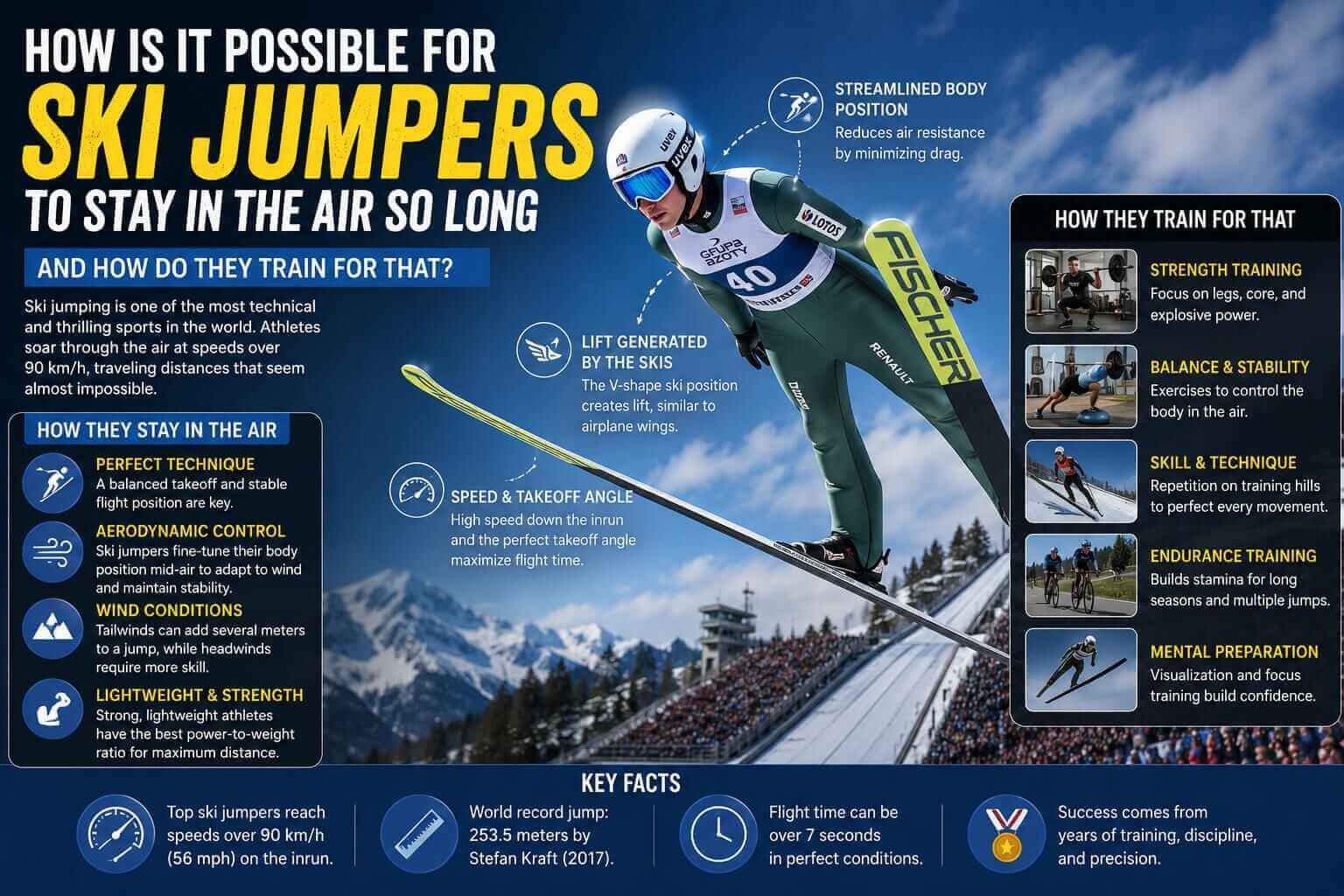
How Is It Possible for Ski Jumpers to Stay in the Air So Long and How Do They Train for That?
If you watched the 2026 Milano Cortina Winter Olympics and found yourself asking — How is it possible for ski jumpers to stay in the air so long, and how do they train for that? — You’re not alone. Millions of people searched that exact question in February 2026 after watching athletes float the length of a football field before landing with surgical precision on a steep snow slope below.
The answer covers two things: physics that makes extended flight possible, and a 12-month training system built to master it. Neither is complicated once it’s explained properly. Let’s get into it.
Most people watching ski jumping assume the athletes are simply launched into the air and coast on momentum until gravity wins. That’s not what’s happening.
When a ski jumper leaves the ramp, they immediately adopt a position that turns their entire body into an aerodynamic wing — the same physical principle that keeps aircraft airborne. Dr. Amy Pope, a physicist at Clemson University who has written about ski jumping for Smithsonian Magazine, describes the result clearly: ski jumpers are staying in the air for 5 to 7 seconds, managing to fly like a glider with no extra support.
For comparison, Michael Jordan’s famous hang time is approximately 0.9 seconds. Ski jumpers beat that by a factor of 6 or 7 — and on ski flying hills, some exceed 9 seconds. That gap is not athletic ability alone. It is controlled aerodynamics, built deliberately through years of training.
The Physics: Three Forces Control Every Jump
Every second of a ski jump is a negotiation between three forces. Get this right, and everything else in the sport makes sense.
Gravity pulls the jumper downward at 9.8 m/s². Athletes cannot reduce this. Every strategy in ski jumping is about counteracting it indirectly — not eliminating gravity, but slowing its effect on descent.
Lift is the upward force generated when air flows over a shaped surface at speed. A ski jumper leaning flat toward the ground with skis spread in a wide V creates exactly this effect. The angled body deflects air downward — and by Newton’s third law, air pushes the jumper upward with equal force. Additionally, air moves faster over the top surface of the jumper’s body than underneath, creating lower pressure above them. This is Bernoulli’s principle, the same mechanism that generates lift on an airplane wing.
A well-positioned ski jumper descends vertically at only 2 to 3 meters per second while traveling horizontally at 25+ meters per second. That ratio — nearly flat flight — is what produces the spectacle. Without lift, they would plummet at the rate of any falling object.
Drag is air resistance working against forward motion. As a jumper slows, they generate less lift — so drag management is just as important as lift maximization. On the in-run, athletes minimize drag to build maximum speed. During flight, they accept carefully calibrated drag that does not reduce lift disproportionately.
The V-Style: The Technique That Changed Everything
Before 1985, ski jumpers kept their skis parallel during flight. Swedish jumper Jan Boklöv then began experimenting with spreading his ski tips outward in a V-shape. Wind tunnel testing confirmed the aerodynamic result: the V-style increases lift by approximately 30% compared to the old parallel position.
The mechanism is straightforward. A wider V creates more surface area for air to act upon. More surface area at the correct angle means more air deflected downward, which generates more upward reaction force. The jumper’s torso presses forward and down into the gap between the skis, completing the airfoil shape. The entire athlete becomes the wing.
What mainstream coverage rarely mentions is that the V-angle is not a fixed setting. A wider V increases lift but also increases drag, which costs speed and therefore reduces lift later in the flight arc. Narrower angles preserve speed at the cost of immediate lift. Elite athletes and coaches determine the optimal V-angle for each specific hill during training — including wind tunnel sessions where lift and drag are measured in real time without the risk of an actual jump.
There is also the matter of ankle flexion — how the front of each ski tilts relative to the airflow. This fine-tunes the lift coefficient during flight. Elite jumpers actively adjust ankle flexion as their speed changes through the flight arc. It is not instinct. It is trained precision, repeated thousands of times until it becomes automatic.
How Far and How Long Do Ski Jumpers Actually Fly?
Concrete numbers help here:
- Normal Hill (K-point ~95m): Flight time of 4–6 seconds, distances around 90–110 meters
- Large Hill (K-point ~125m): Flight time of 6–7 seconds, distances around 120–145 meters
- Ski Flying Hills (K-point ~185m): Flight time exceeding 8–9 seconds, with some jumps beyond 250 meters
The world record stands at 291 meters, set by Stefan Kraft of Austria in 2017. That jump lasted approximately 9 seconds — a human being airborne for nearly three American football fields from a standing start.
At the 2026 Milano Cortina Winter Olympics, competition took place at the Predazzo Ski Jumping Stadium. The Games debuted the Women’s Large Hill Individual event for the first time in Olympic history, alongside the new Men’s Super Team format — a significant expansion of the sport.
The Equipment Rules That Govern Every Jump
Ski jumping equipment is among the most tightly regulated in Olympic sport — because without regulation, aerodynamic equipment advantages would make athletic skill secondary.
Ski length is capped at 145% of the jumper’s height. Longer skis create more lift surface, which incentivizes being as light as possible. This created a serious problem.
The BMI rule and the eating disorder crisis: Through the 1990s and early 2000s, the aerodynamic advantage of being light drove a dangerous weight-cutting culture in the sport. A study found that 22% of jumpers at the 2002 Salt Lake City Games were below the minimum BMI recommended by the World Health Organization. German jumper Frank Löffler publicly stated in Der Spiegel that he was put on a 1,200-calorie-per-day diet and given an ultimatum to drop from 72 to 68 kilograms or face consequences.
FIS Race Director Walter Hofer described the period directly: “In the late 90s, we had in our sport the so-called ‘lightweight issue’ where athletes tended to reduce their weight to get a better performance on the jumping hill, and we couldn’t get rid of it.”
In 2004, FIS introduced a rule linking maximum ski length to the athlete’s BMI. Athletes with a BMI below 21 must use shorter skis — reducing their aerodynamic advantage. Research published subsequently confirmed the rule reduced extreme underweight cases, though studies also found it is still aerodynamically beneficial to be lighter within certain limits, meaning the underlying pressure has not fully disappeared. Olympic gold medalist Maren Lundby of Norway has spoken publicly about the ongoing challenge, urging young athletes not to make dangerous decisions about weight.
Suits are made from spongy microfiber with regulated air permeability and must stay within 2 cm of the body at every point. A suit even slightly too loose functions like a partial squirrel suit — generating extra lift through additional surface area. Five athletes were disqualified at the 2022 Beijing Games after suit measurements failed compliance checks. Officials measure suits before every major competition.
How Is It Possible for Ski Jumpers to Stay in the Air So Long and How Do They Train for That?
The physics answers the first half of the question. The training system answers the second — and it runs 12 months a year, year after year, for most of an athlete’s childhood and early adulthood.
Wind Tunnel Training
Wind tunnels are where aerodynamic precision is built without the consequences of a real jump. In a typical training jump, an athlete is airborne for 5 to 7 seconds. In a wind tunnel running at 140–170 km/h, they can hold a flight position for minutes at a time while coaches measure lift and drag forces in real time.
The wind tunnel facility in Stockholm, used by multiple national teams, is angled to match the profile of a ski jumping landing hill — making the simulation particularly accurate. Athletes can experiment with micro-adjustments to V-angle, hip position, arm placement, and head angle while receiving immediate feedback. That feedback loop is impossible during an actual jump. Wind tunnels make it possible.
Summer Hills and Plastic Slopes
Snow is seasonal. Training jumps are not. Elite facilities use plastic-coated in-runs and landing slopes that function year-round. Athletes train on these surfaces from May through October, taking hundreds to thousands of training jumps per season. The takeoff and flight mechanics are nearly identical to winter conditions. Only the landing surface differs.
Volume matters enormously at the junior level. Elite junior athletes may take 300–500 training jumps in a single summer season. By the time an athlete reaches World Cup competition, the volume base from years of repetition is already built — training at that level becomes more focused on precision than raw repetition.
Strength and Plyometric Training
The takeoff extension — the explosive push off the ramp — happens in under 0.3 seconds. Generating maximum force in that window requires elite fast-twitch muscle activation. Training to develop this includes plyometric work: box jumps, depth jumps, single-leg bounding, and explosive step-ups.
Core stability training is equally important. The flight position — flat, forward-leaning, arms tight against the body — requires holding a precise aerodynamic shape against significant air pressure forces for the entire flight duration. Pilates, isometric holds, and balance work are standard components of a ski jumping conditioning program.
Body weight is managed carefully. Strength training is calibrated to build explosive power without adding mass — because every additional kilogram directly costs jump distance.
Mental Training and Fear Management
This is the dimension most coverage ignores, and it is not peripheral.
Elite ski jumpers stand at a starting gate 60 to 80 meters above the landing zone, then voluntarily accelerate to 90 km/h before launching into open air. Most people, standing at that gate, would not jump once. Elite athletes do it hundreds of times a year under competitive pressure.
Psychological training includes structured visualization protocols — mentally rehearsing every phase of the jump with full sensory detail before physical execution. Athletes also develop arousal regulation skills, learning to channel pre-competition anxiety into performance enhancement rather than technical breakdown. Process focus training keeps attention on technique cues — ankle angle, arm position, takeoff timing — rather than the height or the crowd.
Progressive exposure is how this is built from the ground up. Junior athletes begin on small training hills with foam landing pits and advance systematically, building competence and confidence in parallel. Athletes who have the physical skills but cannot manage the psychological demands of elite competition do not reach the top of the sport. Coaches at the Norwegian, Austrian, and German programs — which have dominated the sport for decades — treat mental training as equivalent in importance to technical and physical development.
How Long Does It Take to Reach Elite Level?
Most elite ski jumpers begin training between the ages of 7 and 12. Junior competition typically starts at 14 to 16. Reaching World Cup level generally requires 8 to 12 years of systematic development. Olympic qualification requires consistent performance across multiple competitions — most athletes are in their late teens to mid-twenties at their first Games.
The sport demands a specific combination: light bodyweight, explosive leg power, aerodynamic intelligence, technical precision under pressure, and psychological toughness in genuinely frightening conditions. This combination is rare, which is why the sport is dominated by a handful of nations with the infrastructure and coaching systems to develop it over long timescales.
Frequently Asked Questions
How is it possible for ski jumpers to stay in the air so long and how do they train for that?
Ski jumpers generate aerodynamic lift by turning their body and skis into a wing — spreading skis in a V-shape and leaning flat toward the ground. This lift force partially cancels gravity and dramatically extends airborne time. They train for it through wind tunnel sessions, year-round jumps on plastic summer hills, explosive strength training, and systematic psychological conditioning — built over 8 to 12 years of development.
How many seconds do ski jumpers stay in the air?
Between 4 and 6 seconds on normal hill, 6 to 7 on large hill, and 8 to 9+ seconds on ski flying hills. The world record jump of 291 meters by Stefan Kraft lasted approximately 9 seconds of total airborne time.
What is the V-style in ski jumping?
A technique introduced in the mid-1980s where athletes spread ski tips outward in a V-shape during flight, rather than keeping skis parallel. Wind tunnel research confirmed it increases aerodynamic lift by approximately 30%. It is now universal in the sport at all competitive levels.
Why are ski jumpers so light?
Lighter athletes produce a better lift-to-weight ratio — the aerodynamic forces acting on their bodies have less mass to overcome, so they fly farther. FIS introduced a BMI-linked rule in 2004 that forces athletes below BMI 21 to use shorter skis, reducing the aerodynamic gain from being underweight. Research confirms the rule reduced extreme cases, though aerodynamic incentives to be lighter within healthy limits still exist.
What do ski jumpers do in summer when there is no snow?
They train on plastic-coated artificial hills that allow year-round jumping, use wind tunnels running at 140–170 km/h to practice flight position, do plyometric and core strength training in the gym, and work on visualization and mental conditioning. Training is essentially 11 months per year.
Why were five ski jumpers disqualified at the 2022 Beijing Olympics?
Their suits failed compliance measurements. Ski jumping suits must stay within 2 cm of the body at every point. A slightly loose suit acts like a partial wingsuit — generating extra lift from additional surface area. FIS measures suits before every major competition and disqualifies athletes whose suits do not comply.
Conclusion
How is it possible for ski jumpers to stay in the air so long, and how do they train for that? The physics answer: they generate aerodynamic lift by converting their body into a human wing, using speed, surface area, and angle to partially cancel gravity for 5 to 9 seconds of flight. The training answer: a 12-month system of wind tunnels, plastic summer hills, explosive gym work, and psychological conditioning, built from childhood and refined over more than a decade.
What you’re watching when a ski jumper soars 130 meters down a hill without falling is applied aerodynamics executed by a trained human airfoil operating at the limit of what physics and nerve allow. Every second in the air is earned — by a takeoff timed in milliseconds, an ankle angle adjusted mid-flight, and a mindset forged on some of the most terrifying starting gates in sport.