
ChatPic | Fast, Safe & Free Image Sharing for Everyone
The Short Answer (For People Who Want to Know)
- ChatPic was a free, anonymous image-sharing platform. You uploaded a photo, got a link, shared it instantly — no account, no email, no sign-up. It ran from 2014 to late 2023 and attracted millions of users who wanted fast, frictionless image sharing.
- The original ChatPic.org is permanently offline. It shut down in late 2023 and has not returned. If you are seeing a site that calls itself ChatPic today, it is not the original — read the mirror sites section below before you use it.
- The fastest, safest replacement in 2026 is PostImage — no account required, unlimited free uploads, and it works exactly like ChatPic did. Full comparison of all alternatives is further down this page.
What Was ChatPic? The Real Story

ChatPic launched in 2014 with one idea: sharing an image online should take less than 30 seconds and require nothing from you.
No username. No password. No profile picture. No privacy settings to configure. No terms of service to tick through. You opened a page, selected a photo from your device, and within seconds, you had a working link you could send to anyone, anywhere.
That sounds ordinary now. In 2014, when every major platform was racing to collect more data, build bigger profiles, and keep you logged in longer, ChatPic was doing the opposite. It was genuinely unusual — and that is why it grew.
Who Used It and Why
ChatPic built its audience across three distinct groups of people:
- Students and everyday sharers used it the way people use WhatsApp to send photos today — except without the file size limits and without needing to be in the same chat thread. You could share a screenshot of coursework feedback, a photo of a handwritten note, or a meme you found funny, and the recipient did not need any app or account to view it.
- Gaming communities relied on it heavily. Sharing in-game screenshots, game clips saved as GIFs, inventory screenshots, and bug reports to developers all worked seamlessly on ChatPic. Forum posts on Reddit, NeoGAF, and gaming-specific boards regularly embedded ChatPic links for exactly this reason.
- Privacy-conscious users chose it deliberately. In an era of growing concern about data harvesting, a platform that collected nothing felt refreshing. No advertising profile was being built from your uploads. No algorithm was analysing what you shared to sell you something. You shared a photo and moved on.
How It Actually Worked
The technical simplicity of ChatPic was its product. There was no backend complexity visible to users — but the platform had a few features that made it feel like more than just a file host:
- Category browsing: Let you explore uploaded images without searching. Nature, wallpapers, gaming, memes, humour, photography — loose categories that made ChatPic feel like a community rather than a storage service. You could lose an afternoon scrolling through wallpaper uploads the same way you might browse Reddit.
- Comment sections on every image: Meant that even without accounts, people could talk. A photograph of a mountain got comments about where it was taken. A meme got riffs in the replies. A screenshot of a game bug got sympathetic responses from people who had seen the same thing. An anonymous community built one image at a time.
- Zero compression on most file types: Appealed to photographers and designers who were tired of platforms squashing their images into lower-resolution versions. What you uploaded was what the recipient downloaded.
Why Did ChatPic Shut Down? The Honest Timeline
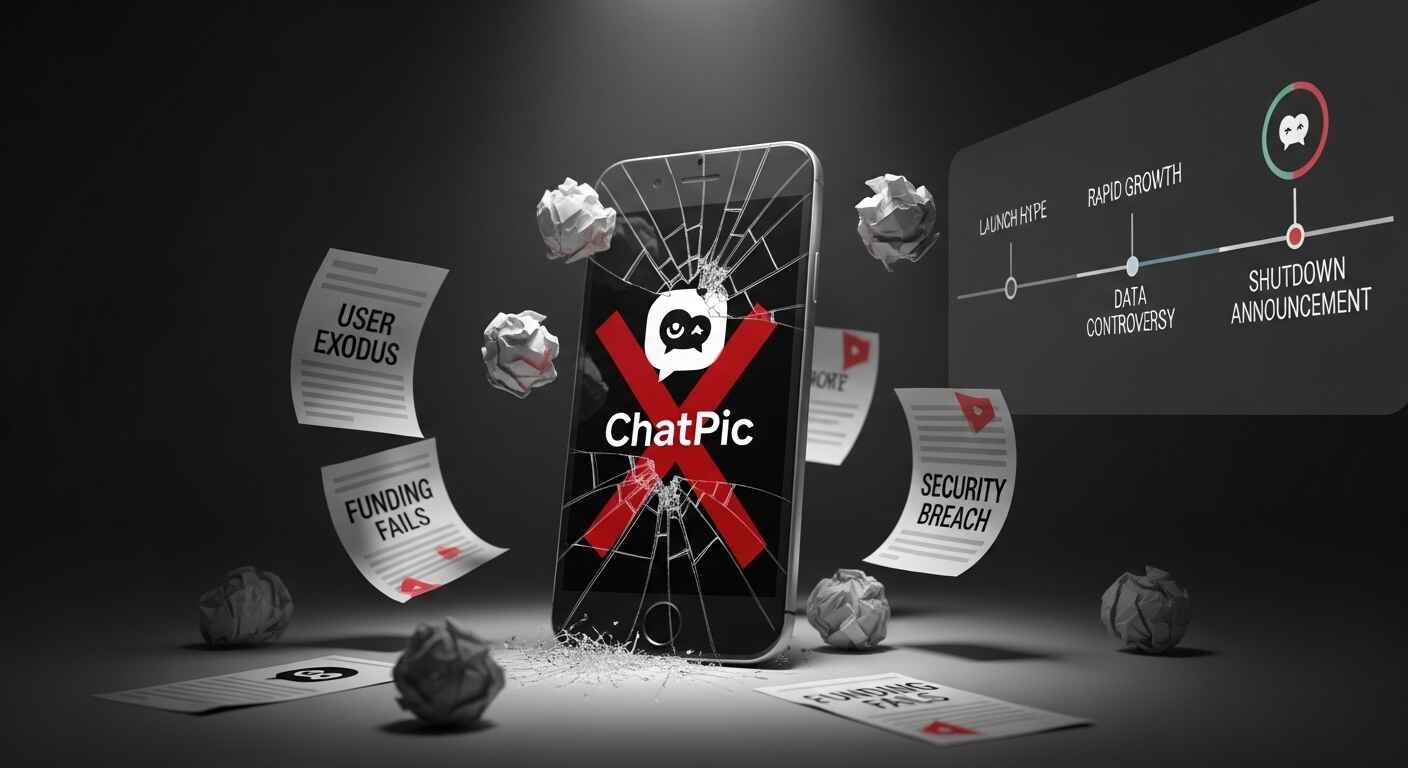
ChatPic’s closure was not a sudden decision. It was the end of a process that took several years and involved failures at every level — design, moderation, legal compliance, and commercial infrastructure. Here is what actually happened:
- 2014–2017: Growth without consequences. ChatPic’s anonymous design worked well at a small scale. Harmful content existed but was manageable. The platform had minimal moderation and received minimal scrutiny.
- 2018–2020: Scale changes everything. As monthly users climbed into the millions, the same anonymity that protected legitimate users began protecting others. Non-consensual intimate images — private photographs shared without the subject’s knowledge or permission — began appearing in volume. Reports were filed. Most went unanswered.
- 2021: The tipping point. The volume of harmful content reached a level that attracted formal attention. Advocacy organisations in the UK and the United States began documenting specific cases. The National Center for Missing and Exploited Children (NCMEC) filed formal reports. Content involving minors was identified on the platform, triggering mandatory reporting obligations under US and UK law.
- 2022: Commercial pressure begins. Payment processors reviewed their relationship with ChatPic and began withdrawing. Hosting providers conducted due diligence reviews. The UK Online Safety Act moved through Parliament, introducing direct legal liability for platforms that failed to moderate illegal content — a liability that ChatPic had no infrastructure to meet.
- 2023: Collapse. Payment processors cut ties entirely. Hosting providers refused renewal. By late 2023, ChatPic.org went offline permanently. No official statement was published. No data export was offered. Images that had been hosted there for years disappeared overnight.
The lesson ChatPic’s story teaches is not complicated: a platform’s design philosophy creates its culture, and its culture determines its fate. Zero accountability attracted zero-accountability behaviour, and at scale, that behaviour became legally and commercially unsurvivable.
Is ChatPic Still Available in 2026?

No. And this is worth being direct about because the question is one of the most common reasons people land on this page.
The original ChatPic.org has been permanently offline since late 2023. ChatPic When you visit the domain today, you will see an error, a redirect, or a blank page. This is not a temporary outage. The platform did not move to a new domain. There is no successor service run by the original operators.
If ChatPic is loading for you right now, you are not on the original platform. You are on a mirror site — an independently created copy using the ChatPic name. Whether that site is safe or not is a different question. The answer is almost always: probably not. Here is how to find out.
ChatPic Mirror Sites: What They Are and How to Identify Them
Within days of ChatPic.org going offline, copycat sites began appearing. By 2024, there were dozens. Most are still active in 2026. None is affiliated with the original platform. None are subject to its terms, its policies, or whatever moderation framework the original had in place (which was minimal anyway).
Understanding why mirror sites are dangerous requires understanding what they are built for. The majority are not genuine attempts to revive the service. They are built to generate advertising revenue from people searching for ChatPic, to harvest personal data from users who sign up or submit their email, or both. Several identified between 2024 and 2025 contained scripts that installed tracking software on visitor devices without any deliberate action from the user.
Six Warning Signs You Are on an Unsafe ChatPic Site
- Check the domain registration date: Use any free WHOIS lookup tool and search the domain name. If it was registered after November 2023, the original platform was already gone when this site was created. That alone does not make it dangerous — but it tells you it has no connection to the original service.
- Look for the HTTPS padlock: Any site handling image uploads without SSL encryption is technically unsafe. If your browser shows a warning or there is no padlock icon in the address bar, leave immediately.
- Find the Privacy Policy: Every legitimate platform operating in the UK is required by UK GDPR to publish a Privacy Policy that is accessible from the homepage. If you cannot find one linked in the footer, the site is not compliant with UK law. That should concern you.
- Notice what the site asks for: The original ChatPic required nothing from you. If a site calling itself ChatPic asks for your email address, asks you to create an account, or asks you to download anything before showing content, that behaviour is inconsistent with the original service and consistent with data harvesting.
- Watch for redirects and pop-ups: Advertising fraud infrastructure commonly uses pop-ups, redirect chains, and download prompts. If clicking anywhere on the page triggers a redirect to an unrelated site or a download dialogue, close the tab.
- Read the moderation policy: Legitimate platforms that operate under UK law post their content rules. If a site has no visible moderation policy, you have no information about what is being hosted there alongside your content.
The 7 Best ChatPic Alternatives in 2026 — Tested and Compared
These platforms were evaluated in March 2026 against the criteria that mattered most to ChatPic users: Can you upload without an account? How long do images stay online? How large a file can you upload? Does the platform automatically remove hidden location data from your photos? And is the free tier genuinely useful?
PostImage — The Closest Replacement for ChatPic
No account required. Unlimited storage. File sizes up to 24 MB. Fast upload, clean interface, no compression on standard image formats. PostImage supports anonymous uploads with moderation and privacy controls, which is exactly the combination ChatPic lacked. The one thing to know before you use it: PostImage does not automatically strip EXIF data from your photos. If your image was taken on a smartphone, remove the location metadata before uploading. Instructions for doing this are in the next section.
Best for: Everyday sharing, forum embeds, Discord links, quick anonymous sends.
Imgur — Community, Stability, and Longevity
Imgur has been operating since 2009 and is one of the most stable image hosts on the internet ChatPic, with hundreds of millions of hosted images and a large active community. Anonymous uploads are possible without an account. EXIF data, including location, is automatically stripped on upload. Content is moderated. The platform has been operating reliably for over fifteen years and shows no signs of going anywhere.
The trade-off compared to ChatPic: Imgur is more feature-rich, which means it is slightly more complex. There are community features, voting systems, and a front page of popular images. If you just want a link, you can still get one in seconds — but the interface is busier than ChatPic’s was.
Best for: Meme sharing, reaction images, gaming screenshots, anything you want to survive long-term.
ImgBB — The Best Option for Temporary Sharing
ImgBB is the platform ChatPic never was: anonymous uploads with optional automatic deletion. You can set an image to expire after five minutes, one hour, one day, one week, one month, or never. No registration required for basic uploads. File sizes up to 32 MB. This expiry feature is the single most useful thing ImgBB offers that ChatPic never had — if you are sharing something you only need available temporarily, set it to expire, and it disappears automatically.
Best for: Support tickets, temporary previews, one-time shares, anything you do not want online permanently.
Catbox — For Large Files
Catbox’s headline feature is its file size limit: 200 MB for free anonymous uploads. Every other platform on this list draws the line at 10–32 MB. If you are sharing a large JPEG, a high-resolution PNG, or a longer video clip, Catbox is the only free anonymous option that handles it without complaint. EXIF data is not automatically stripped, so remove metadata before uploading personal photographs.
Best for: Large files, RAW images, anything that exceeds the limits on other platforms.
Imgbox — Simple, Clean, No Frills
Imgbox is the most minimal option available in 2026. No account required, unlimited storage, no compression, direct links. The file size limit of 10 MB is the most restrictive on this list, which rules it out for large images. For standard-sized photographs and screenshots, it works cleanly and without fuss. Think of it as the least feature-heavy option — which, depending on what you want, is exactly the point.
Best for: Users who want simplicity above everything else.
Flickr — For Photographers
Flickr requires an account, which immediately disqualifies it for anonymous sharing. What it offers in return is everything a serious photographer actually needs: 1,000 photos free, file sizes up to 200 MB, automatic EXIF stripping including GPS data, genuine privacy controls, and an audience of photographers who appreciate good work. If you are sharing personal photography that you care about, Flickr is the only platform on this list that treats it with the respect it deserves.
Best for: Photography portfolios, creative work, images you want to survive and be seen properly.
Google Photos — For Personal Storage
Google Photos is not a sharing platform in the sense that ChatPic was. It is a personal backup and storage service that happens to allow sharing. Fifteen gigabytes free, automatic EXIF stripping, private unless you explicitly share, and accessible from any device you are logged into. The requirement for a Google account is a meaningful barrier for users who valued ChatPic’s anonymity. For everyone else, it is the most reliable free photo storage available.
Best for: Backing up your own photos, sharing albums privately with family or friends.
Full Comparison Table
| Platform | No account needed | Max file size | Strips location data | Free storage | Top use case |
|---|---|---|---|---|---|
| PostImage | Yes | 24 MB | No — remove first | Unlimited | Closest to ChatPic |
| Imgur | Optional | 20 MB | Yes — automatic | Unlimited | Community sharing |
| ImgBB | Yes | 32 MB | No — remove first | Unlimited | Expiring links |
| Catbox | Yes | 200 MB | No — remove first | Unlimited | Large files |
| Imgbox | Yes | 10 MB | No — remove first | Unlimited | Pure simplicity |
| Flickr | No | 200 MB | Yes — automatic | 1,000 photos | Photography |
| Google Photos | No | Unlimited | Yes — automatic | 15 GB | Private backup |
The Hidden Risk in Every Photo You Share: EXIF Data Explained
This is the section most image-sharing guides skip. It is the most practically useful thing on this page.
Every photograph taken on a modern smartphone contains invisible embedded data called EXIF (Exchangeable Image File Format). This metadata travels inside the image file itself. It is not visible when you look at the photo. It is fully readable by anyone who downloads it and opens it in a metadata reader. Here is what it can contain:
- GPS coordinates — the precise latitude and longitude of where the photo was taken, often accurate within 10 metres
- Device model — the make and model of your phone or camera, sometimes including a serial number
- Timestamp — the exact date and time of capture, to the second
- Software version — the operating system and camera app running when the photo was taken
- Owner name — if configured in device settings, the registered owner’s full name
When you upload a photo to PostImage, ImgBB, Catbox, or Imgbox — platforms that do not automatically strip EXIF data — that information is accessible to anyone who downloads your image. A photo of your lunch could tell someone exactly which street you live on if it were taken at home. A photo of a document could reveal your device and your location on a specific date and time.
How to Remove EXIF Data Before Uploading — Right Now
- On Windows: Right-click the image file → Properties → Details tab → click “Remove Properties and Personal Information” → tick “Remove the following properties from this file” → Select All → OK. Done in under 30 seconds, works on any JPEG or PNG.
- On iPhone (iOS 16 or later): Open the photo in the Photos app → tap the information icon (the circle ⓘ at the bottom) → tap Adjust under the location → tap None. On older iOS versions, use a free EXIF remover app from the App Store.
- On Android: In Google Photos, open the image → tap the three dots → Details → tap the location shown and remove it. In Samsung Gallery, open the image → tap Details → uncheck location information.
- On any device: A free browser-based EXIF remover lets you upload an image, strips all metadata including GPS, device, and timestamp data, and lets you download the clean version. No installation required.
Sharing Images Safely in 2026 — Three Rules That Actually Matter

There is a lot of generic “stay safe online” advice available. These three rules are specific and actionable for anyone sharing images in 2026.
- Rule one: Remove EXIF data before uploading to any platform that does not do it automatically: Imgur and Flickr strip it for you. PostImage, ImgBB, Catbox, and Imgbox do not. If you are uploading to the latter group and your photo was taken on a phone, strip the metadata first using the instructions above.
- Rule two: Never upload private or sensitive photographs to any anonymous platform: “Anonymous” describes the upload mechanism, not the security of the content. It means no one knows who uploaded it, not that no one can see it, download it, or share it further. Once an image is on a public anonymous platform, you have no control over what happens to it.
- Rule three: Keep local copies of anything you care about: ChatPic’s closure demonstrated this with brutal clarity. Millions of images hosted on the platform vanished overnight when the service went down. Free image hosts — even stable ones — can close, change their policies, delete old content, or suffer data loss. Your photos belong on your own device or in a personal backup service like Google Photos. Treat public image hosts as a sharing layer, not a storage layer.
Frequently Asked Questions
Is ChatPic still available in 2026?
No. The original ChatPic.org permanently closed in late 2023 following legal pressure from child safety organisations, the withdrawal of payment processors, and the termination of hosting services. The platform has not returned in any form. Any site currently using the ChatPic name is an independently created copy with no connection to the original operators.
What happened to my photos on ChatPic?
When ChatPic.org went offline, all hosted content became inaccessible. The platform offered no data export mechanism before closing. There is no official successor service that holds the original content. If you did not save your images locally before the shutdown, they cannot be recovered through any available mechanism.
Is chatpic.co.uk the same as chatpic.org?
No. ChatPic.co.uk is an independent UK-based information resource. We cover the history of ChatPic.org, explain why it closed, help users identify unsafe mirror sites, and provide tested comparisons of safe alternatives. We do not host images and have no affiliation with the original platform or any of its former operators.
Can I still share images anonymously in 2026?
Yes. PostImage and ImgBB both allow uploads without any account or personal information. Several legitimate platforms support anonymous uploads with moderation and privacy controls. ChatPic — the difference from ChatPic is that these platforms have real content moderation, which is what makes them safe to use and legally sustainable.
Are ChatPic mirror sites safe to visit?
Most are not. Mirror sites typically operate without content moderation, without legal compliance, and without any privacy protections. Several have been identified as containing malware delivery scripts or data harvesting forms disguised as account creation pages. Use the six-point checklist earlier on this page to assess any site before uploading content to it.
Was ChatPic legal?
Sharing images anonymously is legal. ChatPic’s problem was not the mechanism of sharing — it was the content it failed to moderate. Non-consensual intimate images, content involving minors, and images used in targeted harassment are all illegal in the UK, regardless of how they are shared. ChatPic allowed all of these to be shared without consequences until those consequences caught up with the platform itself.
Is anonymous image sharing legal in the UK in 2026?
Yes. The UK Online Safety Act 2023 regulates platforms and their obligations to moderate content — it does not make anonymous image sharing illegal for users. What is illegal is the content itself in certain categories, regardless of how it is uploaded. Uploading your own photographs or freely shareable images to a legitimate anonymous platform is entirely lawful.
The Bottom Line
ChatPic filled a real gap. Fast, free, anonymous image sharing with no barriers and no data collection was genuinely useful for millions of people, and nothing has replaced it entirely. The platforms above come closest — PostImage in particular does most of what ChatPic did, legally and sustainably.
What ChatPic taught us is that speed and simplicity are not enough on their own. A platform that protects its users has to be able to moderate the content it hosts. The alternatives above all do that. None of them is perfect. All of them are better than using an unverified mirror site that may be harvesting your data or hosting content that puts you at legal risk just by being on the same platform.
Use PostImage for anonymous sharing. Use Imgur for the community. Use ImgBB when you want the link to expire. Strip your EXIF data before you upload to anything. Keep your own copies of photos that matter.
That is all the practical guidance you need.
ChatPic.co.uk is an independent UK information resource. We do not host images. We have no affiliation with the original ChatPic.org platform. For corrections or enquiries: info@chatpic.co.uk