
United Airlines Flight UA770 Emergency Diversion
What Really Happened and What It Means for Air Travel
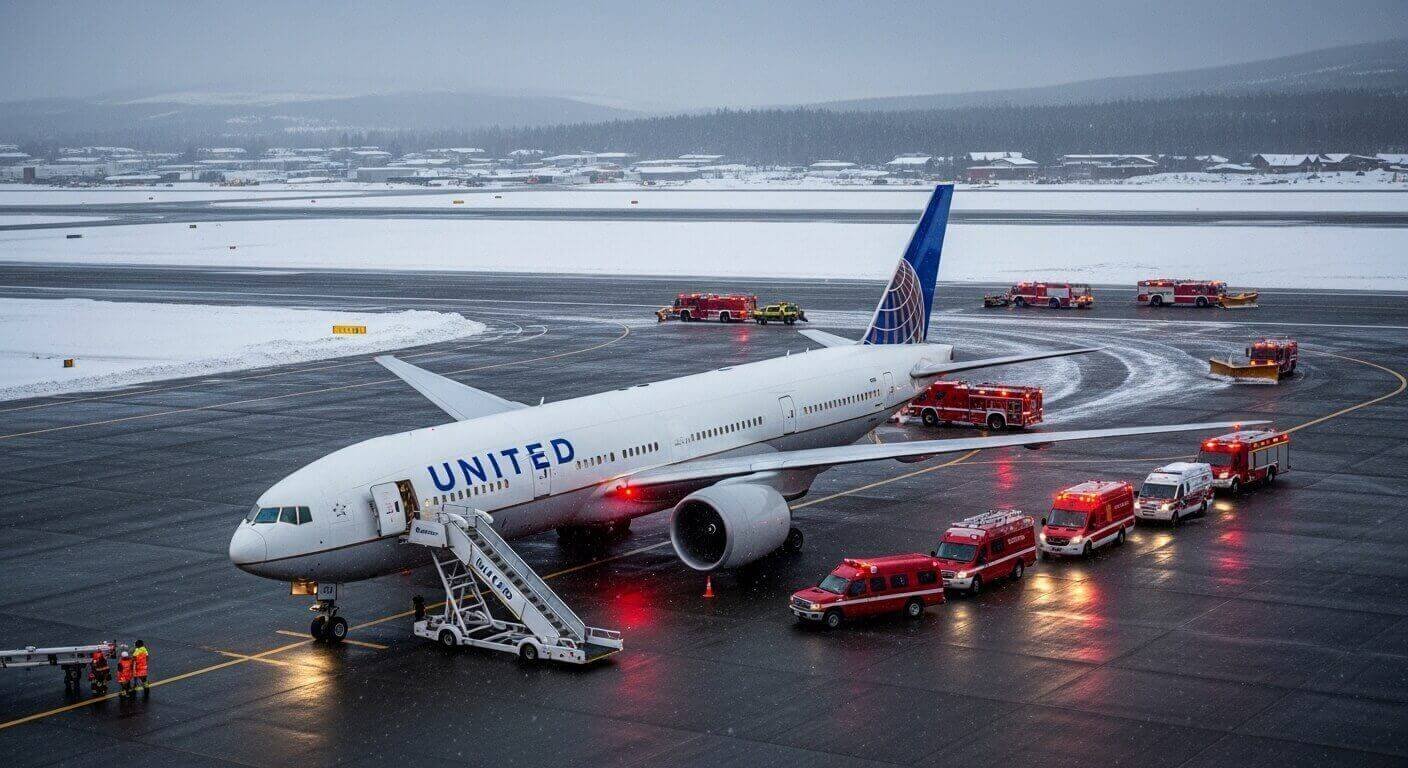
On May 27, 2025, thousands of aviation trackers, nervous families, and curious travellers watched their screens as United Airlines Flight UA770 — bound from Barcelona to Chicago — suddenly changed course mid-Atlantic and headed for London. The pilots had squawked 7700: the universal aviation code for a general emergency. Within minutes, one of the world’s busiest airports went into emergency reception mode.
Nobody was hurt. The plane landed safely. But the story of the United Airlines Flight UA770 emergency diversion is about far more than one flight on one afternoon. It’s a window into how modern aviation works when things don’t go to plan — and why the system is designed exactly for moments like this.
Whether you’re searching for the UA770 flight status, trying to understand what happened to passengers on board, or simply curious about how airline emergency protocols operate, this guide covers everything you need to know.
The Flight at a Glance — UA770 Route and Aircraft Details
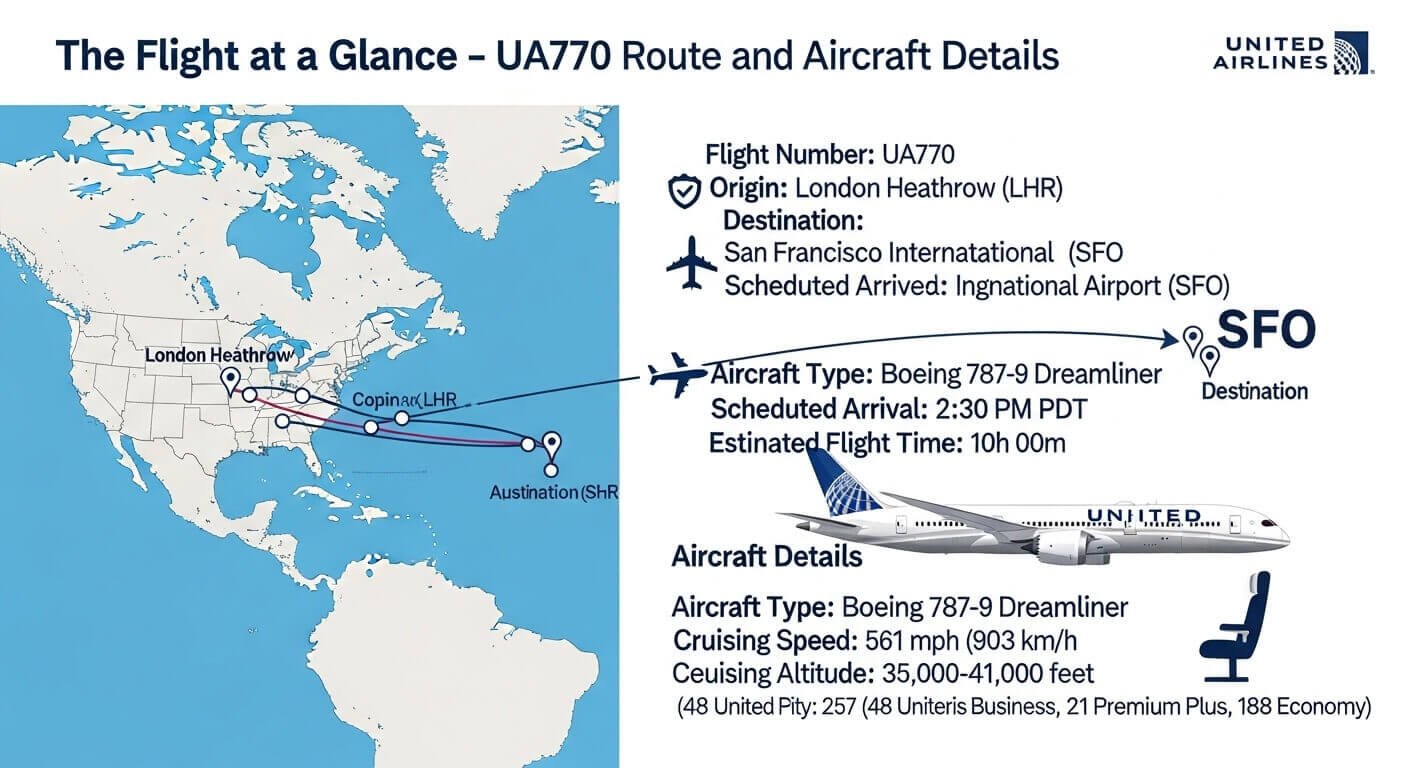
United Airlines Flight UA770 operates as a scheduled long-haul transatlantic service connecting Barcelona El Prat Airport (BCN) and Chicago O’Hare International Airport (ORD). It’s the kind of route that carries business travellers, holidaymakers, and families crossing the Atlantic on one of the most reliable aircraft in commercial aviation today.
The aircraft operating the flight on May 27, 2025, was a Boeing 787-9 Dreamliner, registered N26902. The Dreamliner is widely regarded as one of the most advanced commercial aircraft ever built, featuring composite materials for lighter weight, highly efficient Rolls-Royce engines, and a cabin pressurisation system that operates at a lower altitude equivalent than older aircraft — making it significantly more comfortable on long-haul routes.
The flight carried more than 250 passengers and 12 crew members. By any standard measure, it was a routine transatlantic crossing — until it wasn’t.
What Triggered the UA770 Emergency Declaration
The Pressurisation Alert Over the North Atlantic
Somewhere over the North Atlantic, cruising at altitude, the flight deck of UA770 received a cockpit warning related to the aircraft’s cabin pressurisation system. Pressurisation is what keeps the air inside the cabin breathable at 35,000 feet, where outside air pressure is far too low to sustain human life without assistance.
Critically, this was not a confirmed loss of cabin pressure. No oxygen masks dropped. Passengers did not experience hypoxia or physical distress. What the crew received was an alert — a warning indicator suggesting a possible irregularity in one of the pressurisation control systems.
In most situations on the ground, a warning light might prompt you to investigate before acting. At 35,000 feet over open ocean, you act first and investigate later. That’s not overcaution — that’s the standard operating procedure that keeps people alive.
Why the Crew Declared a General Emergency
The pilots responded immediately by running the relevant checklists, contacting United Airlines operations on the ground, and communicating with North Atlantic air traffic control. After assessing the situation, they made the decision to declare a general emergency — squawking transponder code 7700.
Squawking 7700 does several things simultaneously. It alerts every air traffic control facility that can see the aircraft’s transponder. It grants the aircraft immediate priority handling. It clears the airspace. And it ensures that every airport in range is ready to receive the aircraft with full emergency services standing by.
The decision to declare was not dramatic. It was professional, measured, and exactly what the training demands.
Why London Heathrow Was Chosen as the Diversion Airport
The Nearest Suitable Hub
When diverting a wide-body transatlantic aircraft with 250-plus passengers, you don’t just land at the nearest runway. You land at the nearest airport that can actually handle what comes next — emergency servicing, passenger care, aircraft inspection, rebooking infrastructure, and Boeing 787-9 maintenance capability.
London Heathrow checked every box. It is one of the busiest and best-equipped airports in the world for wide-body emergency arrivals, with:
- Long runways capable of handling fully-loaded 787-9 aircraft
- Round-the-clock emergency services with wide-body experience
- Boeing Dreamliner maintenance and engineering support
- Comprehensive passenger facilities for rebooking, meals, and, if necessary, accommodation
- Strong onward connection options for hundreds of rebooked passengers
The Landing: Runway 27R, Gate B44
UA770 landed safely on Runway 27R at London Heathrow at approximately 4:55 PM BST. Emergency vehicles were staged as a precaution, standard practice for any 7700 arrival. The aircraft taxied under its own power to Gate B44, where ground crews and airline representatives were ready to receive passengers.
A planned stopover of approximately one hour was announced initially, giving engineers time to inspect the aircraft before any decision on continuing the flight was made.
No injuries were reported. No passenger required medical attention. The cabin, by all accounts, remained calm throughout.
Inside the Cabin — What Passengers Experienced
What separates a manageable emergency from a chaotic one is almost always crew communication. On UA770, passengers described an environment that was tense but orderly. The captain made a clear announcement about the situation and the decision to divert. Flight attendants moved through the cabin professionally, checking seatbelts and answering questions calmly.
No oxygen masks were deployed, which confirmed to passengers that the pressurisation system had not failed — the aircraft was operating normally, and the diversion was a precautionary response to an instrumentation alert rather than an active emergency in the cabin.
Social media activity around the flight spiked quickly after landing, with passengers posting updates using UA770 flight tracking information. Most accounts described relief, appreciation for the crew’s composure, and frustration at the disruption rather than fear about what had happened.
That response from passengers is itself a measure of how well the situation was handled.
How United Airlines Responded on the Ground
Passenger Rebooking and Ground Support
Once the aircraft was secured at Gate B44, United Airlines activated its standard emergency ground response. Passengers were:
- Met by gate agents with rebooking assistance
- Offered access to United’s customer service channels for updated flight information
- Provided with meal vouchers and communication support
- Rebooked on alternate United Airlines services to Chicago O’Hare and other connecting destinations
For passengers with tight connections, the diversion to London created significant disruption. Heathrow’s extensive onward network — with numerous transatlantic departures to Chicago daily — meant most passengers were rerouted within a few hours.
The Aircraft Inspection
The Boeing 787-9 N26902 underwent technical inspection by ground engineers at Heathrow before any decision was made about returning it to service. This is non-negotiable following an emergency declaration — the aircraft does not fly again until engineers have cleared it.
United Airlines confirmed the emergency diversion publicly and stated that passenger safety had been the sole priority in the crew’s decision-making.
What Is Squawk 7700? Understanding the Emergency Code
One of the most searched questions following this incident was a simple one: What does it actually mean when a pilot squawks 7700?
Every commercial aircraft carries a transponder — a device that broadcasts the aircraft’s identity, altitude, and position to air traffic control radar. In normal operations, aircraft squawk a four-digit code assigned by ATC. Three codes are universally reserved for emergencies:
- 7700 — General emergency (any significant emergency situation)
- 7600 — Radio failure (the aircraft has lost radio communication)
- 7500 — Unlawful interference (hijacking)
When a pilot selects 7700, the transponder broadcasts immediately, flagging the aircraft on every controller’s screen in range. The aircraft receives absolute priority — other traffic is rerouted around it, runway clearance is given instantly, and emergency services are alerted on the ground.
It is the aviation equivalent of clearing the road for an ambulance, except the ambulance is travelling at 500 miles per hour and carrying 250 people.
Aviation Safety Context — How Common Are Emergency Diversions?
Here’s something worth knowing before anxiety about flying takes hold: emergency diversions are far more common than most passengers realise, and the overwhelming majority end exactly as UA770 did — safely, professionally, and without injury.
According to aviation safety data tracked by organisations including the Aviation Safety Network, thousands of diversions occur globally each year. The causes range from technical alerts and medical emergencies among passengers to weather avoidance and fuel concerns. The vast majority of diversions are categorised as “precautionary” — meaning the diversion is prompted by a warning or anomaly rather than an active system failure.
Modern aircraft like the Boeing 787-9 are built with extensive redundancy. Critical systems have backups. Backups have backups. A single sensor alert does not mean a system has failed — it means a system has flagged something that requires investigation on the ground, in a controlled environment, with proper tools and time.
That is the system working correctly. Not failing.
The Boeing 787-9 Dreamliner — Is It a Safe Aircraft?
Given that the aircraft involved in the UA770 diversion was a Boeing 787-9, some observers naturally asked whether the Dreamliner itself has a safety record worth scrutinising.
The short answer is yes — and it holds up well.
The 787 family has logged hundreds of millions of passenger miles across its service life with airlines worldwide. Its composite airframe, advanced avionics, and fuel-efficient systems have made it a flagship aircraft for long-haul routes. United Airlines operates an extensive 787 fleet across its international network, including the Barcelona to Chicago UA770 route.
The pressurisation system alert that prompted the UA770 diversion is not a known systemic flaw with the 787-9. Aircraft pressurisation systems generate alerts that require investigation — alerts designed to prompt action before a minor irregularity becomes a problem. On this occasion, the system worked precisely as designed.
What Happens After an Emergency Diversion — The Investigation Process
Emergency diversions don’t end when the aircraft parks at the gate. They trigger a structured post-incident process involving multiple parties:
- The airline’s maintenance team conducts a full technical inspection of the aircraft and the system that generated the alert. Engineers review flight data recorder information and run diagnostic checks on all relevant systems.
- The aircraft manufacturer’s support team — in this case, Boeing — may be involved in reviewing technical findings, particularly for novel systems like those on the 787 family.
- Aviation regulatory authorities — including the FAA in the United States and the CAA in the United Kingdom — may request post-incident reports depending on the nature of the emergency. While not every diversion triggers a formal regulatory investigation, a 7700 squawk over the North Atlantic will generate documentation reviewed by safety authorities.
- The airline’s safety and operations teams review crew decisions, communication logs, and passenger experience reports to identify any procedural improvements.
This multi-layered review process is part of why commercial aviation continuously improves. Every incident — even one that resolves without injury — feeds into a global body of knowledge that makes the next flight safer.
Lessons From the UA770 Diversion for Travellers
If you fly regularly on international routes — particularly transatlantic services like the UA770 Barcelona to Chicago route — the events of May 27, 2025, carry a few genuinely useful takeaways.
- Crew training is the most important safety system on any aircraft. The technical alert on UA770 could have been dismissed or minimised. Instead, the captain and first officer followed checklists, communicated clearly with ATC, and made a conservative, safety-first decision to divert. That decision-making process is the product of thousands of hours of training and regular simulation exercises.
- Diversions are not disasters. The word “emergency” understandably triggers alarm. But aviation emergencies exist on a vast spectrum, and the vast majority of 7700 squawks result in precautionary landings with no harm to anyone on board. The label reflects the seriousness with which aviation takes any anomaly, not the probability of catastrophe.
- Know your passenger rights when diverted. If you are on a flight that diverts due to a technical issue, you are entitled to rebooking, care, and potentially compensation depending on the regulations that apply. For transatlantic flights operating to or from Europe, EU Regulation 261/2004 governs many of these entitlements. Contact your airline’s customer service team and keep receipts for any expenses incurred during the disruption.
Monitoring UA770 Flight Status — Tools and Resources
For passengers booked on UA770 or family members tracking a flight, several reliable tools provide real-time flight tracking and status information:
- United Airlines’ own flight status tool — available via the United Airlines website and the United mobile app — provides the most authoritative and up-to-date information on any United Airlines flight, including UA770.
- FlightAware and Flightradar24 are widely used third-party aviation tracking platforms that display real-time aircraft positions, departure and arrival times, and historical flight data. These tools allow you to see exactly where UA770 is at any point during its flight.
- ADS-B Exchange provides unfiltered transponder data, including squawk codes, which is how aviation enthusiasts and news organisations track incidents like the May 27 diversion in real time.
For the most accurate and current United Airlines flight status, always cross-reference the airline’s official channels with third-party tracking data.
Final Thoughts — Key Takeaways From the UA770 Emergency Diversion
The United Airlines Flight UA770 emergency diversion on May 27, 2025, was a textbook example of aviation safety protocols operating as designed. A pressurisation system alert over the North Atlantic prompted a general emergency declaration. The crew diverted to London Heathrow — the closest, best-equipped airport for this type of arrival. The Boeing 787-9 Dreamliner landed safely. No one was hurt. Passengers were rerouted. Engineers inspected the aircraft.
It was inconvenient. It was disrupting. And it was exactly right.
The story of UA770 is ultimately a story about a system that works — trained pilots, redundant aircraft systems, equipped airports, and coordinated ground response all functioning together to turn a potential problem into a non-event. That is what modern commercial aviation looks like at its best.
FAQs
What caused the United Airlines Flight UA770 emergency diversion?
The flight crew received a cockpit alert related to the aircraft’s cabin pressurisation system while cruising over the North Atlantic. Although there was no confirmed loss of cabin pressure, standard operating procedures required the crew to treat the alert with the highest priority. They declared a general emergency and diverted to London Heathrow as the nearest major hub with full emergency and maintenance support.
Was anyone injured on UA770 during the emergency diversion?
No. All passengers and crew on board UA770 were unharmed. No oxygen masks were deployed, and there were no reports of any passenger or crew member requiring medical attention. The cabin remained calm throughout the diversion and landing.
What does squawking 7700 mean in aviation?
Squawk 7700 is the international transponder code for a general emergency. When a pilot selects this code, the aircraft is immediately flagged on all nearby air traffic control radar screens and given absolute priority handling. It alerts controllers and ground services that the aircraft requires urgent assistance and clears the airspace and runway for an expedited approach and landing.
What airports does UA770 normally fly between?
United Airlines Flight UA770 operates between Barcelona El Prat Airport (BCN) in Spain and Chicago O’Hare International Airport (ORD) in the United States. It is a regular transatlantic service operated by a Boeing 787-9 Dreamliner.
What are passengers entitled to when a United Airlines flight is diverted?
Passengers on diverted flights are typically entitled to rebooking on the next available service to their destination, along with meal vouchers, communication access, and — if an overnight stay is required — accommodation. For flights covered by EU Regulation 261/2004 (flights departing from EU airports or arriving in the EU on EU-based carriers), additional compensation rights may apply depending on the cause of the disruption and the delay to final arrival.
How can I check the real-time status of UA770?
The most reliable source for United Airlines flight UA770 status is the United Airlines official website or mobile app under the “Flight Status” section. Third-party tools, including FlightAware, Flightradar24, and ADS-B Exchange, also provide real-time tracking data and historical flight information for UA770.
Is the Boeing 787-9 Dreamliner a safe aircraft?
Yes. The Boeing 787-9 has a strong safety record across hundreds of millions of passenger miles flown globally. The pressurisation alert that prompted the UA770 diversion is not indicative of a systemic flaw in the aircraft type. The Dreamliner’s systems are designed with multiple redundancies specifically to detect anomalies early and alert crews before minor issues can escalate — which is precisely what happened on May 27, 2025.