
How to Identify If a Pashmina Shawl Is Genuine: 9 Reliable Tests
Real vs Fake Pashmina — A Plain-English Guide for First-Time Buyers
The Short Answer
A genuine Pashmina shawl feels cloud-soft and warms your hand within seconds. It burns like hair — not plastic. It weighs almost nothing. It has slight weave irregularities from handloom work. A GI-tagged piece carries a unique serial number you can verify online in 30 seconds.
If a shawl fails even two of those checks, walk away.
Why This Matters More Than Ever
The global market for counterfeit Pashmina is enormous. Shawls made entirely from acrylic, viscose, polyester, and cheap merino wool blends are sold openly — at tourist markets, in reputable-looking shops, and on major e-commerce platforms — labeled as “Pashmina” without a single fiber of genuine pashm inside.
This happens because “Pashmina” is not a legally protected term in most countries outside India. Any seller can put that word on a label without penalty. The only protection a buyer has is knowing exactly what to look for.
This guide gives you that knowledge, test by test.
What Genuine Pashmina Actually Is
Before you can spot a fake, you need to understand what the real thing is.
Genuine Pashmina comes from one specific animal: the Changthangi goat, also called Capra Hircus. This goat lives only in the Changthang plateau of Ladakh, at altitudes between 14,000 and 15,000 feet. Winters there reach minus 40 degrees Celsius.
To survive, the goat grows an ultra-fine undercoat beneath its coarser outer fur. This undercoat is called pashm. Every spring, herders gently comb — never shear — this undercoat from the goat by hand.
Here is the detail most people don’t know: each individual pashm fiber is 12 to 16 microns in diameter. For comparison, a single human hair is 50 to 70 microns thick. Pashm is roughly four times thinner than your own hair. That extreme fineness is what creates the softness, the warmth, and the weight that make genuine Pashmina unlike any other fabric.
That fiber is then hand-carried to Kashmir, where artisan women hand-spin it into thread on a traditional wooden spinning wheel called a yinder. The thread is then hand-woven on a traditional wooden loom called a khatamband. A plain, unembroidered shawl takes 6 to 18 months to complete. An embroidered Kani shawl can take years.
That entire journey — from a specific goat on a Himalayan plateau to a finished shawl — is why genuine Pashmina has the price it has. And why do sellers put the name on cheap substitutes?
A 60-Second Diagnosis Before You Run Any Test
Do this first. It saves time and tells you where to focus.
- Test on mobile data first: Open your phone on mobile data — not Wi-Fi. Try to find the seller’s name on a government-registered artisan database or a certified e-commerce platform. This takes 60 seconds and filters 80% of untrustworthy sellers before you even touch the fabric.
- The phone call test for online buyers: Call or message the seller. Ask: “What is the micron count of this shawl?” A genuine seller knows the answer immediately: 12 to 16 microns. A fake seller will not understand the question, deflect, or give a vague answer. This single question filters out most fraudulent sellers in under one minute.
- The price filter: This is your fastest lie-detector. Genuine handwoven Pashmina cannot be produced and sold profitably below ₹8,000 in India or $200 internationally. If the price is lower, do not waste time on any other test. Move on.
The 9 Tests to Identify Genuine Pashmina
Test 1 — The Touch and Warmth Test
Pick up the shawl. Lay it flat on your open palm. Hold it there for ten seconds without gripping it.
Genuine Pashmina does two things almost simultaneously. It feels feather-light — a full-sized shawl should weigh between 150 and 200 grams, roughly the weight of two apples. And it warms your palm within seconds, even in a cool room. This is the insulating quality of ultra-fine animal fiber, trapping your body heat immediately.
Run your fingertips across the surface. You will feel a very subtle, barely-there texture — almost like the finest peach fuzz. That is the natural nap of the pashm fiber. It is not as smooth as synthetic fabric is smooth. It has warmth and depth to the touch.
Synthetic shawls are immediately identifiable once you know what to compare them to. Viscose and polyester feel cool and slippery. Acrylic has a slight plastic quality and may feel light, but it does not warm your hand quickly. Blended “Pashmina” with added silk feels artificially glossy.
One word to remember: genuine Pashmina feels warm, not smooth. Synthetic fabric feels smooth, not warm.
Test 2 — The Weight Test
This is one of the most overlooked tests in every other guide.
Ask to hold the full shawl in both hands. A genuine plain Pashmina shawl — approximately 200cm × 70cm — weighs between 150 and 200 grams. Some very fine twill-woven pieces can be even lighter.
If the shawl feels noticeably heavy in your hands, it almost certainly contains synthetic fiber or heavy wool blended in to add bulk. Fake Pashmina is often heavier than the real thing — not lighter. This surprises most buyers who assume softness and lightness always go together, but the weight check quickly exposes blended or low-quality materials.
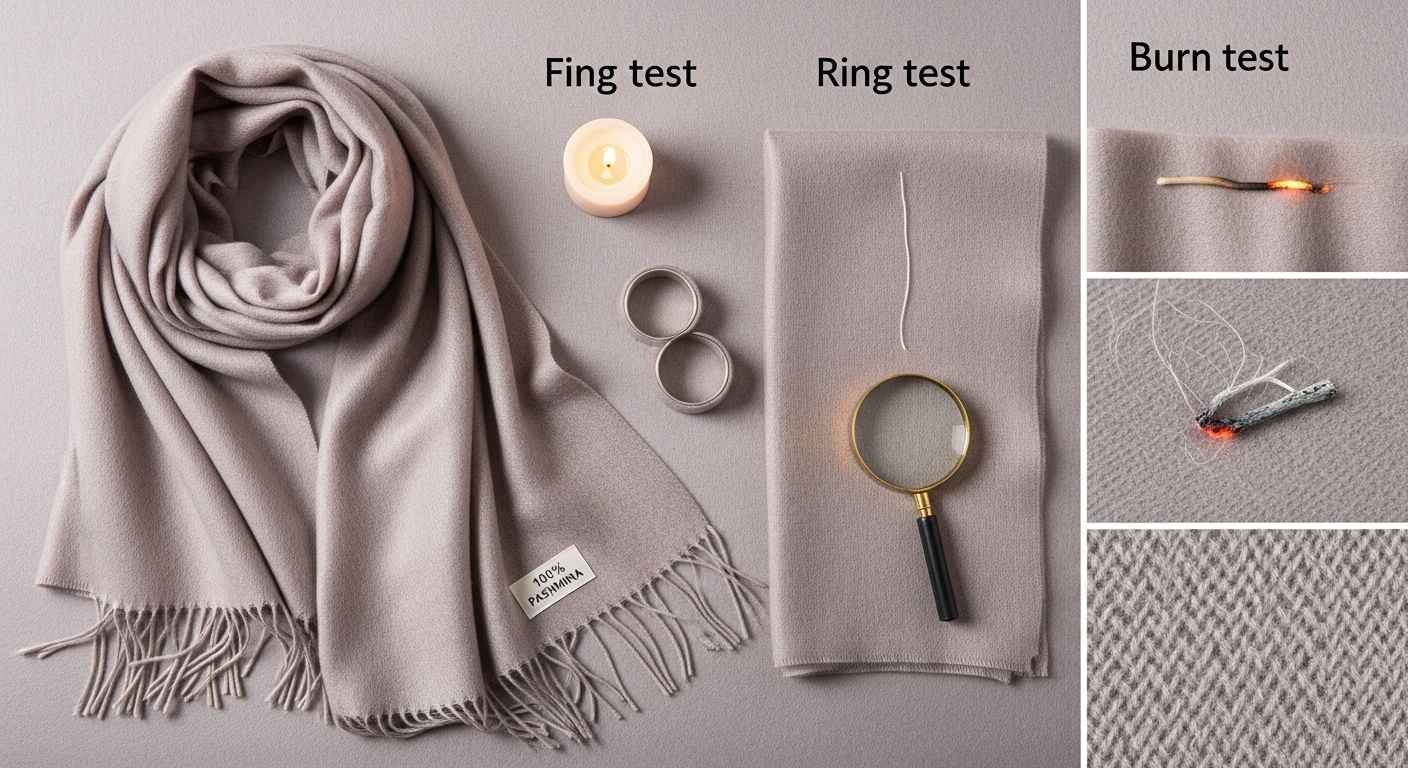
Test 3 — The Burn Test
This is the most reliable test of all. Chemistry cannot be faked.
Ask the seller for permission to pull a single loose thread from the fringe at the edge of the shawl. Hold it with tweezers over a non-flammable surface. Apply a flame.
- Genuine Pashmina (animal protein fiber): Burns slowly and self-extinguishes when the flame is removed. Smells exactly like burning human hair — a recognizable, organic smell. Leaves behind a small amount of soft, grey, powdery ash that crumbles completely between your fingers.
- Fake Pashmina (synthetic fiber): Melts rather than burns. Continues burning or smoldering after the flame is removed. Smells sharply of burning plastic — a chemical, acrid odor that is unmistakable. Leaves behind hard, dark, bead-like residue that does not crumble.
- Pashmina-silk blend (partially genuine): Burns with a slightly different smell — still organic, not plastic — but the residue may be slightly harder than pure pashm. A silk-blend is not fake, but it is not pure Pashmina. You are buying a blend.
If a seller refuses to allow this test, that refusal is your answer.
Test 4 — The Weave and Light Test
Hold the shawl up toward a window or bright light source. Spread it fully.
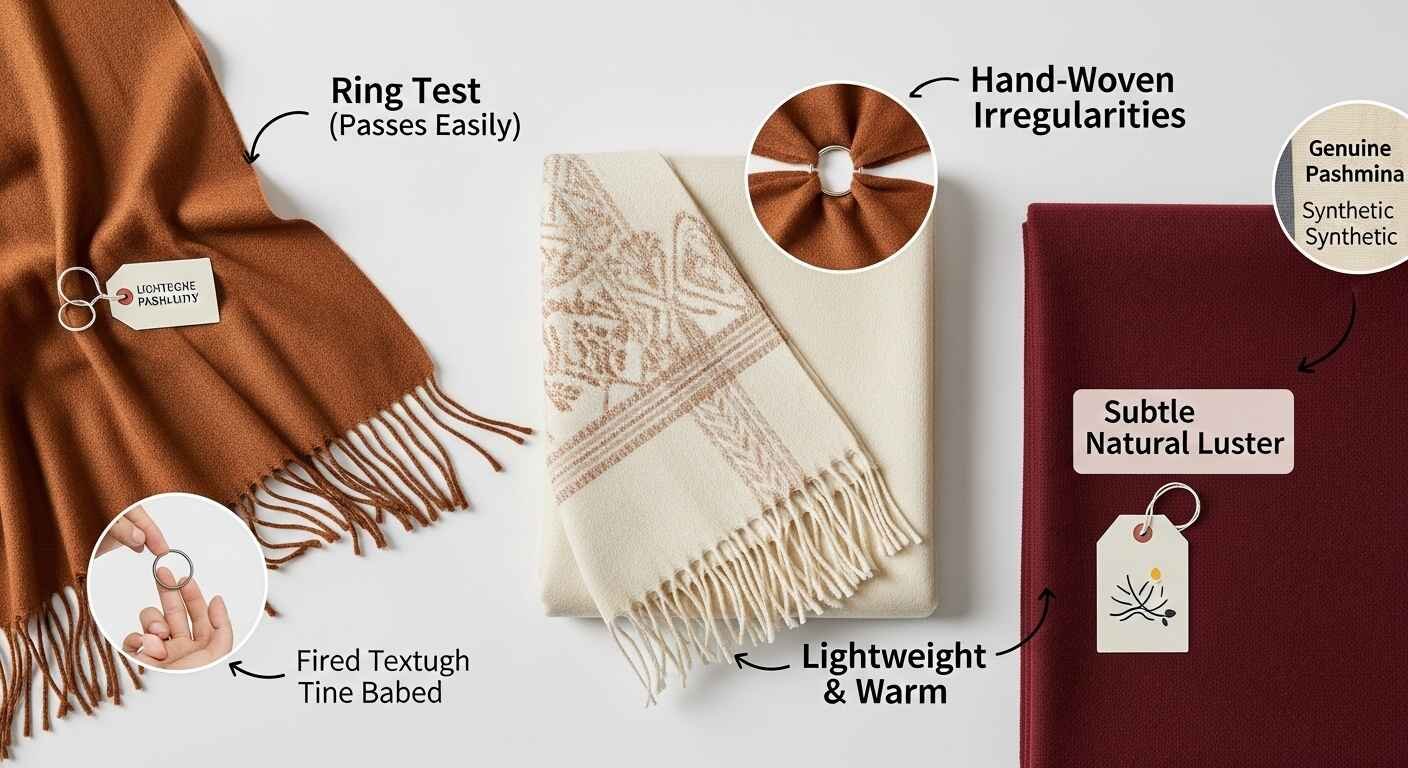
Genuine handwoven Pashmina reveals a fine, airy weave structure with tiny, irregular gaps between the threads. You will see slight variations in thread thickness. The spaces between threads are not perfectly uniform. The tension shifts subtly from row to row. These are the natural fingerprints of a human hand guiding the loom.
Machine-woven fabric looks completely different under light. Every thread is identical in thickness. The spacing is mathematically consistent. The pattern repeats with factory-floor precision. It looks like a grid rather than a weave.
Also look at the selvedge — the long finished edges of the shawl running along its length. On a handwoven piece, the selvedge has a very slight undulation, almost like a gentle wave. On a machine-made piece, the selvedge is a perfectly straight, rigid line. This selvedge check is one of the most reliable tests that almost no other guide mentions.
Test 5 — The Static Test
Rub a section of the shawl gently between your palms for 10 seconds.
Genuine Pashmina, like all natural animal fiber, generates almost no static electricity. The fabric will not stick to your hands or attract nearby objects.
Synthetic materials build static charge almost immediately when rubbed. You will feel a slight tingling. In a darkened room, you may even see tiny sparks. The fabric will cling to your hands or attract small pieces of dust or tissue.
This test takes 10 seconds and is clear-cut.
Test 6 — The Fringe Test
Look closely at the fringe — the loose threads at both short ends of the shawl.
On a genuine handwoven Pashmina, the fringe is made from the actual warp threads of the shawl itself, released from the loom after weaving. These threads are hand-twisted and naturally finished. They are slightly irregular in thickness. Each strand has an organic, hair-like quality. The length may vary slightly from strand to strand.
On a machine-made or fake shawl, the fringe is added separately — sewn or glued onto the finished edge. It looks too uniform. Every strand is the same thickness, the same length, finished with the same knot. The attachment point where fringe meets shawl often shows visible stitching or a small folded hem.
Also, check the corners of the shawl. Genuine handwoven Pashmina has slightly rounded, softly finished corners — a natural result of handloom work. Machine-made pieces have perfectly sharp, mathematically precise corners.
Test 7 — The Ring Test (With Its Important Limits)
This is the most famous Pashmina test. It is real — but widely misunderstood.
Take the shawl and loosely gather it into a soft rope. Try to pull this gathered fabric through a standard finger ring. A genuine, finely woven plain Pashmina shawl can pass through because the fibers are so thin and the weave is so light.
Here is what most guides get wrong: some thin synthetic shawls can also pass through a ring. The ring test alone is not a reliable standalone verification. Use it as one test in combination with others — not as the only test.
More importantly, some heavier genuine Pashmina pieces — a thick Kani shawl, a dense double-woven piece, or an embroidered shawl with added thread weight — may not pass through a ring and are still completely genuine. A shawl not passing the ring test is not proof of fakery. A shawl passing the ring test is not proof of authenticity. It is simply one data point.
Test 8 — The Pilling Test
This one you cannot do in the store. But it confirms authenticity after purchase better than anything.
Genuine Pashmina will develop small, soft, removable pills on its surface after regular use. These tiny balls of fiber appear because ultra-fine pashm fibers are delicate — they interlock slightly and ball up through friction. This is completely normal. You can remove them easily with a cashmere comb or even your fingers.
If a seller specifically tells you, “This Pashmina will never pill,” treat that as a warning. Synthetic fibers either never pill (because they are too strong to break) or develop harsh, plasticky, hard pilling that cannot be removed easily. Soft, removable pilling is a hallmark of genuine animal fiber — not a defect.
Test 9 — The GI Tag Verification (The Official Government Test)
This is the single strongest proof of authenticity for Kashmiri Pashmina — and it is consistently under-explained in every other guide.
The Government of India, through the Craft Development Institute (CDI) in Srinagar, issues a Geographical Indication (GI) certification to genuine Kashmiri Pashmina. In October 2024, Ladakh’s Pashmina wool received its own separate GI registration through the Ministry of Textiles, further strengthening the certification system.
For a Pashmina shawl to receive GI certification, it must meet four specific criteria:
- The fiber must come 100% from Capra Hircus (Changthangi) goats
- Fiber fineness must be 16 microns or below
- The yarn must be hand-spun only
- The weaving must be done by hand by registered local artisans in Kashmir
Each certified shawl receives a rubber-base holographic sticker with a unique serial number. The sticker has serrated edges. If anyone tries to peel it off, it self-destructs — it cannot be removed intact and reused. No two shawls share the same ID.
How to verify the GI tag yourself:
Step 1: Find the GI tag sticker on the shawl. It is usually attached at one corner or to the label.
Step 2: Scan the QR code on the tag using your smartphone camera. It links to the official Pashmina Authentication Website.
Step 3: Alternatively, visit the official portal and enter the unique serial number manually. A genuine entry will display “Kashmiri Pashmina” with the producer’s details, artisan registration number, and certification date.
Step 4: If the number does not appear in the database, or if the sticker appears damaged or reprinted, the certification is not valid.
Important note: Not every genuine Pashmina carries a GI tag. Some small independent weavers, especially those selling directly, work outside the formal certification system. The absence of a GI tag does not automatically mean a shawl is fake. But a verified GI tag is the strongest available guarantee of authenticity — and its presence makes all other tests secondary.
Genuine vs Fake: The Complete Comparison Table
| Feature | Genuine Pashmina | Pashmina Blend | Fake “Pashmina” |
|---|---|---|---|
| Fiber source | Changthangi goat, Ladakh | Mix of pashm + silk/wool | Acrylic, viscose, polyester |
| Fiber thickness | 12–16 microns | Varies | 20+ microns or synthetic |
| Weight (full shawl) | 150–200 grams | 200–300 grams | 250–450 grams |
| Burn result | Hair smell, soft ash | Hair smell, slightly firm ash | Plastic smell, hard beads |
| Static when rubbed | None | Minimal | Immediate and strong |
| Weave under the light | Irregular, airy, human | Semi-irregular | Perfectly uniform |
| Fringe origin | Warp threads of the shawl | Usually sewn-on | Sewn or glued-on |
| Pilling over time | Soft, removable pills | Light pilling | No pills or hard plastic pills |
| GI tag available | Yes (for certified pieces) | No | No |
| India price range | ₹8,000 – ₹5,00,000+ | ₹3,000 – ₹15,000 | ₹200 – ₹2,000 |
| International price | $200 – $8,000+ | $80 – $250 | $5 – $40 |
The Faux Pashmina Trap — A Legal Loophole Nobody Talks About
This is the blind spot every other guide ignores.
In most countries, the word “Pashmina” is not legally protected as a textile term. Sellers exploit this freely. Here are the exact label phrases that signal a fake — all are technically legal but deliberately misleading:
- “Pashmina blend” — contains a tiny percentage of pashm mixed with viscose or wool. The majority is not Pashmina.
- “Pashmina-style” — contains zero Pashmina. Only looks like it.
- “Pashmina-feel” — no Pashmina at all. Just marketing language.
- “Pashmina viscose” or “Pashmina polyester” — completely synthetic. The word Pashmina here is purely decorative.
- “Himalayan Pashmina” without origin specifics — vague enough to mean nothing. Genuine Kashmiri Pashmina always specifies Kashmir and Ladakh as the origin.
The only label that counts: “100% Pashmina” or “100% Cashmere” with Kashmir or Ladakh specified as origin, ideally with a GI tag attached.
How to Identify Genuine Pashmina When Shopping Online
Online buyers have one major disadvantage: they cannot touch or burn-test before buying. Here is how to compensate.
Read the material composition — not just the title. Many listings title themselves “Luxury Kashmiri Pashmina Shawl” but show “70% viscose, 30% acrylic” in the product details. Always scroll to the composition section. The title is marketing. The composition is the legal statement.
Ask the seller for the micron count before buying. Any seller of genuine Pashmina knows the answer: 12 to 16 microns. If they do not understand the question or give a vague answer, stop.
Check seller’s origin and history. Genuine Kashmiri Pashmina sellers are based in Kashmir, Ladakh, Delhi, or have verifiable partnerships with Kashmiri artisan cooperatives. A generic dropship seller operating from an unrelated country selling “authentic handwoven Kashmiri Pashmina” for $25 is not selling authentic Pashmina.
Look for GI certification on the product listing. Sellers of genuine GI-tagged pieces mention the Craft Development Institute certification or the artisan’s registration number. A seller who has never heard of the GI certification system is not selling certified Pashmina.
Use the price as a pre-filter. Below ₹8,000 in India, below $200 internationally for a full-size shawl — eliminate without further consideration. The production cost alone makes anything lower impossible.
Price Guide: What Real Pashmina Costs in 2026
| Type | India (₹) | International ($) | What Makes the Difference |
|---|---|---|---|
| Plain, solid color shawl | ₹8,000 – ₹25,000 | $200 – $400 | Basic handweaving, no embroidery |
| Sozni hand-embroidered shawl | ₹25,000 – ₹1,50,000 | $400 – $2,500 | Months of fine needle embroidery |
| Kani woven shawl | ₹80,000 – ₹5,00,000+ | $1,500 – $8,000+ | Pattern woven into fabric, years of work |
| Pashmina-silk blend (70/30) | ₹5,000 – ₹20,000 | $120 – $350 | Real pashm + silk — not pure, but legitimate |
| Machine-woven cashmere | ₹3,000 – ₹15,000 | $80 – $300 | Genuine fiber, machine-made |
| Fake “Pashmina” (synthetic) | ₹200 – ₹2,000 | $5 – $40 | No real Pashmina fiber at all |
How to Care for Your Genuine Pashmina Shawl
You have verified it is real. Now protect it.
Hand washes only in cold water. Use a very small amount of gentle baby shampoo or specialist wool wash. Never use regular laundry detergent — the enzymes damage protein fibers.
Never wring or twist it. Gently squeeze water out, then roll the shawl in a clean, dry towel and press gently to absorb moisture.
Always dry flat in shade. Never hang a wet Pashmina — it stretches under its own weight. Never dry in direct sunlight — it fades the fiber.
Store folded in a breathable cotton or muslin bag. Never use a plastic bag — trapped moisture causes fiber damage over time. Add a cedar block or lavender sachet to deter moths.
Use a cashmere comb (not a regular comb) to gently remove any pills that develop. Never pull pills off with your fingers in a single motion — always use a comb or a soft garment brush.
Frequently Asked Questions
Is all cashmere the same as Pashmina?
No. Pashmina is a specific type of cashmere, but the finest type. Pashmina comes specifically from the Changthangi goat of Ladakh and measures 12 to 16 microns. General cashmere comes from various breeds of cashmere goat across China, Mongolia, and Central Asia and measures 15 to 19 microns. All Pashmina is cashmere, but not all cashmere is Pashmina. In terms of softness and warmth-to-weight ratio, genuine Pashmina consistently outperforms standard cashmere.
Can I do the burn test at home after buying?
Yes, absolutely. Pull a single thread from the inner edge of the fringe where it will not be visible. Hold it with tweezers over a metal or ceramic surface. Burn it with a lighter. Genuine Pashmina smells like burning hair and leaves soft, powdery ash. Synthetic fiber melts, smells like plastic, and leaves a hard residue. This test takes 30 seconds and gives a definitive answer.
What does a genuine GI tag look like, and where do I verify it?
A genuine Kashmiri Pashmina GI tag is a small holographic sticker with serrated edges and a unique serial number. It is attached to the shawl at a corner or near the label. To verify it: scan the QR code with your phone, or visit the Pashmina Authentication Website (run by the Craft Development Institute, Srinagar) and enter the unique ID. A genuine result shows “Kashmiri Pashmina” with the artisan’s registration details. If the number returns no result or an error, the certification is not valid.
Why does my genuine Pashmina pill — is it defective?
Pilling on genuine Pashmina is completely normal and is actually a sign of authentic animal fiber. The ultra-fine fibers are delicate and interlock through use, forming small, soft balls on the surface. Use a cashmere comb to gently remove them. Hard, rough pilling that feels plastic and cannot be removed easily is the kind to worry about — that indicates synthetic fiber.
Is a Pashmina-silk blend worth buying?
A genuine Pashmina-silk blend (typically 70% pashm, 30% silk) is a legitimate product. The silk adds sheen, makes the shawl more durable, and allows for more vivid dyeing. It is not the same as pure Pashmina — it is softer to the touch, slightly lighter in feel, with a mild sheen. It is a good value at the right price. The problem arises when sellers charge pure Pashmina prices for a blend, or when “Pashmina blend” means 5% pashm and 95% viscose.
Why does the same shawl cost so much less in a tourist market than in a certified store?
The tourist market version is almost certainly not the same shawl. It contains little to no genuine pashm fiber. The low price reflects the actual cost of production — viscose and acrylic cost almost nothing to spin and weave. A genuine handwoven Pashmina takes months of skilled artisan labor. That labor cannot be priced at ₹500 or $15. The lower the price relative to what genuine Pashmina costs to produce, the more certain you can be that the fiber is not what the seller claims.
Can I get a scientific laboratory test to confirm authenticity?
Yes. If you have purchased a high-value piece and want absolute certainty, you can send a small fiber sample to a textile testing laboratory. They perform microscopic analysis to measure fiber diameter precisely. In India, the Textiles Committee under the Ministry of Textiles offers fiber testing services. Internationally, specialized wool and cashmere testing labs in the UK and the USA can provide certified analysis. This is the most definitive test available, though it is unnecessary for most purchases if you apply the tests in this guide carefully.
Before You Buy: View The Final Checklist
Use this at any shop, market, or online listing before paying.
- Does it feel warm and light, not smooth and cool?
- Does it weigh under 200 grams for a full-size shawl?
- Does the burn test produce hair smell and soft ash, not plastic smell and hard beads?
- Does the weave show slight, natural irregularities when held to light?
- Does the selvedge edge show a subtle wave, not a perfectly straight, rigid line?
- Does the fringe look organic and slightly irregular — not uniform and sewn-on?
- Does it produce zero static when rubbed between your palms?
- Does the label say “100% Pashmina” or “100% Cashmere” — nothing else?
- Is the price above ₹8,000 in India or above $200 internationally?
- Can the seller confirm the fiber micron count (correct answer: 12–16 microns)?
- If a GI tag is present, does the QR code or serial number verify on the Pashmina Authentication Website?
Eight or more checked yes: you are almost certainly looking at the real thing.
Fewer than six checked yes: walk away.
Final Word
Genuine Pashmina is one of the most extraordinary natural textiles on earth. A 600-year heritage. Fiber from a specific goat on a specific Himalayan plateau. Months of skilled hand-spinning and handweaving by artisans in Kashmir. There is nothing else quite like it.
When you buy genuine Pashmina, you are not just buying a warm shawl. You are supporting a living craft tradition, a community of Kashmiri weavers, and the families of Ladakhi herders who have lived alongside the Changthangi goat for generations.
When you unknowingly buy a fake, you fund a market that is slowly eroding that heritage — and you get a synthetic shawl that will feel nothing like what you paid for.
The tests in this guide are simple, reliable, and take minutes. Use them without hesitation. A seller who is proud of their product welcomes every question you ask.